The latest building project is intended to be a storage shed for machinery. The shed I just built the giant door for was also intended to be a storage shed, but as soon as the walls were up, I changed my mind and decided to put hay in it instead. This shed is going to hold all of the stuff that the other was supposed to plus have room for my tractor. That will (hopefully) free up space in the overhang attached to the barn for Ben's cart and let me use that area as a sort of work shop for various other projects. It is also a nice space to be able to trim feet or work with one of the donkeys one-on-one.
I've learned my lessons the hard way about digging holes up here so I decided to rent a mini-excavator for a day. I've never operated one of these before, but I knew it couldn't be all that hard and it just happened to be available last weekend so I went for it.
The first hole was the hardest because I was not familiar with the machine and because I hit some big rocks. Digging up here is really tough. The first 8-10 inches is not so bad, but then you hit hardpan mixed with shale and boulders. Even with this machine, it was hard going. You can't really dig holes so much as carve them out.
I know a lot of people, especially women, are intimidated by heavy machinery, but you shouldn't be. Modern equipment is easy to use, requires no strength and is a tremendous leveler. Every woman I know could operate this machine. Everything on it is controlled by the hands. The left joystick makes the arm reach forward and back and left to right. The right joystick makes the arm lift up/down and tips the bucket forward and back. The two levers in the front make the machine move forward/back and steer. There is one lever on the right that raises and lowers the blade. That's it.
It does take a little practice to get everything coordinated, but it is not difficult. The thing I found the hardest was filling in the holes after the posts were set. That takes a degree of fineness and a lot of caution, because you really don't want to accidentally knock over one of those carefully placed posts while you are trying to fill in its hole. I speak from experience when I say that doing so can lead to an extreme swearing fit.
I did find myself trying to give the machine leg commands like I do on my horse. That was, of course, highly ineffective and caused me to get very tense and possibly swear some more (it's a good thing no one could hear me over the noise of the machine). Once I realized what I was doing, I made myself relax and focus on my hands.
I can actually see where operating one of these could be a good exercise for riders as it forces you to focus on both deliberate and subconscious cues. The machine does exactly what it is told and only that. If you don't give the proper cue, you don't get the proper response.
The other issue with digging holes up here, that has caused me no end of trouble, is this....
As soon as you dig a hole, it fills with water. If the ice gets into the ground far enough in the winter to freeze that water, then the posts heave, hydrants fail, pipes freeze, etc. I dug all of these holes five feet deep. If the frost gets that deep, we're all going to be frozen to death anyway.
I used 4x6 posts instead of 6x6 because they are adequate for this job and I can just barely manage to move them around on my own. Two inches does not seem like much, but the weight difference is all out of proportion to the size.
This shed may seem like it is out in the middle of nowhere, but in reality, it is just behind the barn, almost exactly opposite the hay/wood shed on the other side of the barn.
Once I had the posts in the ground, the next really hard step was to get the headers put up, which are these 2"x12"x12' boards that weigh approximately 12,000 pounds. At least they do when standing on a ladder trying to lift them up by myself.
I had to get a little creative to put these up. I put some temporary "arms" up to hold the board in place and had to put the ladder on the trailer in order to reach high enough.
I had a couple of iffy moments thinking about getting squished and wondering if I belong in a padded room, but it worked in the end. Once I got the system figured out, the rest went up relatively easily.
This will be the back of the building...
The front will remain open. The overall size will be 12'x24' and the opening is about 9 feet high. The next step will be to put up the rafters, which should be easier than the headers since the headers are already there to hold the rafters up for me. The rafters are also lighter. After that, purlins across the rafters, metal roof and siding will go on last.
I thought long and hard about putting this shed up, mostly because it seemed like too much work that I didn't want to do. I kept trying to come up with some easier, cheaper option, including a greenhouse type structure. However, every winter I commute to work and see so many carports, portable buildings, tent-like structures, etc. that are crushed by snow, blown over, or collapsed because of improper construction and it always makes my teeth hurt.
I figure that this building will cost about $1500 when it is all done and it doesn't take that much more effort. Building a temporary structure probably requires just as much skill and swearing. Most of those carport things cost more than $1500 and don't last.
I probably need therapy, but I find that I just can't make myself do that. So, tomorrow, I will probably be out behind the barn trying to remember how to cut the notches in the rafters and further exceeding my quota of swear words.
Friday, September 15, 2017
Monday, September 11, 2017
Fun Things to do on Vacation
Some people take time off from work to travel and recreate. I take time off from work and end up working even harder. Given that the rest of the world is either on fire, flooded or getting blown off the map right now, Hellwind Hill is, for once, the place to be and traveling seems like a very bad idea.
So what are some of the fun things on the vacation agenda? So far, the things that have made the list have been:
- stacking firewood (working on it)
- mowing fields (done)
- cleaning and organizing the tack/feed room (working on that too)
- sheath cleaning for Ben and Ramsey and udder scrubbing for Tessa (DONE!). Emma never needs such attention because that is just far too crude for delicate, finicky little unicorns.
Sunday, September 10, 2017
No Words
I've just learned that another good friend just lost her husband - a good father, a good husband, a good man. Gone too soon.
It has robbed me of words. All the grief, the fires, floods, earthquakes, the massive hurricanes. All of it. What is there to say?
Hold tight to those you love.
It has robbed me of words. All the grief, the fires, floods, earthquakes, the massive hurricanes. All of it. What is there to say?
Hold tight to those you love.
Friday, September 8, 2017
Gone Too Soon
My good friend Riding Buddy suddenly lost one of her best friends today in a tragic accident. Sweet, sweet Maggie was just 2 1/2 years old. Every day of those two years was filled with exuberant fun, hours of play, time with her family, and love. Especially love.
It is so much more than many get, but nowhere near enough. Unfortunately for all of us, it will have to do.
Maggie
February 25, 2015 - September 7, 2017
Goodbye Maggie. We will all miss you terribly.
Thursday, September 7, 2017
Wednesday, September 6, 2017
State of the Farm(s) Address - part 1
I am sooo behind on blogging. But, I am on vacation (yay!!), and I am going to try to get caught up a bit. I have a million projects to do and much to catch up on so I barely know where to start. At the same time, for my own sanity, I have to limit the how much time I spend thinking about all the horrific fires, floods and hurricanes so many are facing right now. I am not oblivious or insensitive to what is going on, but I am powerless. All I can do is focus on the problems I can address and pray for the rest.
***
When you don't know where to start, you should just pick up a tool and do something. They say that 80% of any job is just starting it. I have always found great truth in that and it is true for writing as well. So.....We'll start with Farm Buddy's farm:
We thought Katerina the llama was going to have a baby this year, she was supposed to. However, we waited all summer for a space alien baby to appear, but the mother ship never arrived. Farm Buddy had been hoping for a little llama to keep Katerina company and grow up here to be the next generation of sheep guardian, but it is not to be.
Katerina seems very happy and content now regardless. She is very attached to the sheep and does not appear to be lonely. It certainly has not impaired her ability to stand on three legs, scratch her belly with the fourth and still keep a sharp eye on the horizon. Better coordination than I have.
All of the lambs and calves were born with no problems this Spring with the exception of one calf. He appeared healthy and beautiful at birth, but he did not thrive despite all efforts to help him. He was a beautiful black angus cross who died about a week after birth. That was a very hard blow, both economically and emotionally.
This happens to all farms at some point. Not all babies live and that is just a hard truth. To the massive Agri Business "farms" of today (I hesitate to even use the word farm in that context), the loss of a single calf is nothing. They factor in an expected percentage of losses every year and think no more about it. To a little farm like this, where every animal has a name and is valued, it is a sharp blow.
The rest of the calves are thriving though and growing like weeds. These two chubs were about two months old when I took this photo.
They, and the rest of their gang of thugs, are always looking for mischief.
Jane finally had her baby about a month ago. She was very late because FB had trouble getting her bred last year. Jane turned into her normal Crack-Head crazy self and once again rejected her calf in favor of fixating on FB. Jane is one strange cow, but FB is addicted to milk and Jane is addicted to being milked so it is just a typical, modern-day, co-dependent relationship between two addicts. Dysfunctional, but it works.
Her calf, at just a month old, is nearly as big as the others and is usually the leader in any trouble so being orphaned has not done him any harm. (Sorry for all the blurry pictures. I've just about killed this camera and it is having a great deal of trouble focusing these days, just like me.)
The lambs are doing well. We've had so much rain this year, that the grass kept getting more mature than the sheep like and they all lost a bit of weight for a while. However, we finally got some sun in the past few weeks and the pastures got mowed. The cooler temps and the shorter grass has them all happy and fat once again.
There were several sets of triplets this year and FB gave one of each set (all but one set anyway), to a woman who has wanted to start her own flock. Those three bottle babies landed in the lap of luxury and have become beloved pets. She has been teaching them to walk on leash and, when that doesn't work, her lovely Border Collie keeps them in line.
The full set of triplets that remained here are all noticeably smaller than the rest of the lambs, which proves that pulling one baby from each set to raise on a bottle really is better for everyone.
FB raises 100 meat birds every year. For most of the summer months, they are under foot just about everywhere you turn.
They have free range of the property and FB dotes on them while they are here.
They find that wool makes a very comfy mattress.
They, and the sheep, all like to hang out in the cool barn during the heat of the day.
This Saturday is chicken processing day. These birds are raised for meat and even if they weren't, they would not live much longer. These are not GMO birds, but many years of selective breeding has made them mature large and fast and have short lives. They are not the really freaky Frankenstein (Cornish Rock) birds most people raise for meat. Their legs don't break under their own weight, they are more active and they do more than just sit and eat like the Cornish meat birds we dislike, but they are meat birds.
Since they don't live long, FB makes sure that they, like all the animals, live really well while they are here. We are also very lucky to have a mobile processing unit that comes right to the farm so none of the animals ever has to leave here. No one ever has to get loaded on a truck and transported across country. They grow up here, living on green grass, sunshine and real food. Their end is extremely swift and free of pain or stress.
We believe that it does not matter what you eat, but how you treat it that matters. That applies to everything, whether it is a chicken or a turnip.
I'm sure I've left a great deal out, but it will have to wait as this is already too long and the Border Patrol is yelling at me.
***
When you don't know where to start, you should just pick up a tool and do something. They say that 80% of any job is just starting it. I have always found great truth in that and it is true for writing as well. So.....We'll start with Farm Buddy's farm:
We thought Katerina the llama was going to have a baby this year, she was supposed to. However, we waited all summer for a space alien baby to appear, but the mother ship never arrived. Farm Buddy had been hoping for a little llama to keep Katerina company and grow up here to be the next generation of sheep guardian, but it is not to be.
Katerina seems very happy and content now regardless. She is very attached to the sheep and does not appear to be lonely. It certainly has not impaired her ability to stand on three legs, scratch her belly with the fourth and still keep a sharp eye on the horizon. Better coordination than I have.
All of the lambs and calves were born with no problems this Spring with the exception of one calf. He appeared healthy and beautiful at birth, but he did not thrive despite all efforts to help him. He was a beautiful black angus cross who died about a week after birth. That was a very hard blow, both economically and emotionally.
This happens to all farms at some point. Not all babies live and that is just a hard truth. To the massive Agri Business "farms" of today (I hesitate to even use the word farm in that context), the loss of a single calf is nothing. They factor in an expected percentage of losses every year and think no more about it. To a little farm like this, where every animal has a name and is valued, it is a sharp blow.
The rest of the calves are thriving though and growing like weeds. These two chubs were about two months old when I took this photo.
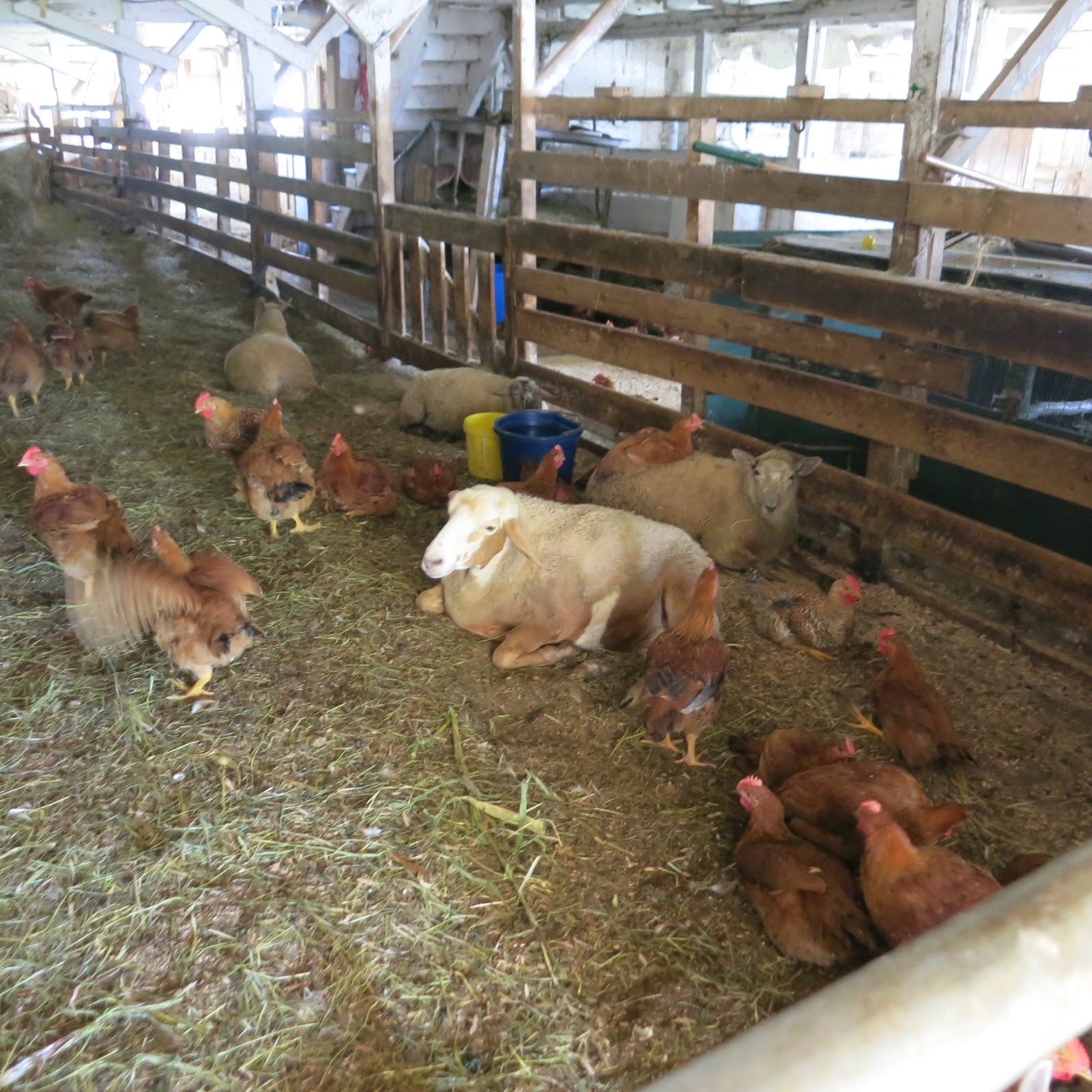
They, and the rest of their gang of thugs, are always looking for mischief.
Jane finally had her baby about a month ago. She was very late because FB had trouble getting her bred last year. Jane turned into her normal Crack-Head crazy self and once again rejected her calf in favor of fixating on FB. Jane is one strange cow, but FB is addicted to milk and Jane is addicted to being milked so it is just a typical, modern-day, co-dependent relationship between two addicts. Dysfunctional, but it works.
Her calf, at just a month old, is nearly as big as the others and is usually the leader in any trouble so being orphaned has not done him any harm. (Sorry for all the blurry pictures. I've just about killed this camera and it is having a great deal of trouble focusing these days, just like me.)
The lambs are doing well. We've had so much rain this year, that the grass kept getting more mature than the sheep like and they all lost a bit of weight for a while. However, we finally got some sun in the past few weeks and the pastures got mowed. The cooler temps and the shorter grass has them all happy and fat once again.
There were several sets of triplets this year and FB gave one of each set (all but one set anyway), to a woman who has wanted to start her own flock. Those three bottle babies landed in the lap of luxury and have become beloved pets. She has been teaching them to walk on leash and, when that doesn't work, her lovely Border Collie keeps them in line.
The full set of triplets that remained here are all noticeably smaller than the rest of the lambs, which proves that pulling one baby from each set to raise on a bottle really is better for everyone.
FB raises 100 meat birds every year. For most of the summer months, they are under foot just about everywhere you turn.
They have free range of the property and FB dotes on them while they are here.
They find that wool makes a very comfy mattress.
They, and the sheep, all like to hang out in the cool barn during the heat of the day.
This Saturday is chicken processing day. These birds are raised for meat and even if they weren't, they would not live much longer. These are not GMO birds, but many years of selective breeding has made them mature large and fast and have short lives. They are not the really freaky Frankenstein (Cornish Rock) birds most people raise for meat. Their legs don't break under their own weight, they are more active and they do more than just sit and eat like the Cornish meat birds we dislike, but they are meat birds.
Since they don't live long, FB makes sure that they, like all the animals, live really well while they are here. We are also very lucky to have a mobile processing unit that comes right to the farm so none of the animals ever has to leave here. No one ever has to get loaded on a truck and transported across country. They grow up here, living on green grass, sunshine and real food. Their end is extremely swift and free of pain or stress.
We believe that it does not matter what you eat, but how you treat it that matters. That applies to everything, whether it is a chicken or a turnip.
I'm sure I've left a great deal out, but it will have to wait as this is already too long and the Border Patrol is yelling at me.
Sunday, September 3, 2017
Avert Thy Gaze
After my rather disastrous attempt last year to take up beekeeping again, I decided I'd had enough and gave up on it. Keeping bees in this climate is expensive and heartbreaking. However, the empty hives have remained sitting out in the field for two reasons:
I haven't done anything more than pull some of the weeds from in front of the hive, but it seems to be a very large swarm that has taken up residence. They are bringing in goldenrod pollen and rather frantically gathering food.
The hive appears to be robust and very active, but a late summer swarm like this faces a truly daunting challenge to gather enough food for the winter and raise enough young bees to survive till spring. August swarms seldom survive and most beekeepers would combine this swarm with another hive to improve the chances of survival.
I have no other hives to combine them with so they are on their own. This hive had large stores of honey left over from the hive that died last winter, which is no doubt what attracted this swarm in the first place. I hope that this leftover honey will give them a much needed boost and a chance to make it.
These bees had to come from local stock who have survived well enough to reproduce, so I am hoping they will be tough enough to make it here on Hellwind Hill. I've decided to maintain my hands-off approach and just leave them to it. I will erect a new wind break for them since they don't stand a chance without it, but otherwise, they are on their own. They are either survivor stock or they aren't.
This may sound harsh, but I've found that trees and plants that need coddling and care from me never survive the winters here. The plants that are tough enough to live through drought, flood and freezing are the only ones that make it. There is no amount of help that I can provide to make them grow if they aren't strong enough to do it on their own and I am not strong enough to keep throwing my energy at lost causes.
The bees are going to have to do the same as the trees because I know that if they can't survive without help, then they never will. I'm sticking with my original plan to avert my gaze and hope for the best because only the strong survive.
- Every time I looked at them and thought about doing something with them, I was filled with a sense of exhaustion and paralyzing indecision. So, I opted for a time honored therapeutic solution I call "Avert Thy Gaze". Sometimes, procrastination really is a good thing.
- I had the vague idea that the hives, still full of honey, might attract a wild swarm. I've had beehives on and off for 15(+/-) years and it has never happened, but hey, it does happen sometimes.
Every now and then I'd wander past the hive looking for a bit of activity. Every time I failed to find any, I'd quickly turn away and revert back my procrastination therapy. It is now very late in the year for swarms and I had quit bothering to even peak occasionally at the hives. I was even starting to form some semi-coherent thoughts about getting rid of them. Then, early this week, I drove past them on the ATV and thought I saw some activity around one of the hives.
I stopped to check it out and, lo and behold, there be bees!
I haven't done anything more than pull some of the weeds from in front of the hive, but it seems to be a very large swarm that has taken up residence. They are bringing in goldenrod pollen and rather frantically gathering food.
The hive appears to be robust and very active, but a late summer swarm like this faces a truly daunting challenge to gather enough food for the winter and raise enough young bees to survive till spring. August swarms seldom survive and most beekeepers would combine this swarm with another hive to improve the chances of survival.
I have no other hives to combine them with so they are on their own. This hive had large stores of honey left over from the hive that died last winter, which is no doubt what attracted this swarm in the first place. I hope that this leftover honey will give them a much needed boost and a chance to make it.
These bees had to come from local stock who have survived well enough to reproduce, so I am hoping they will be tough enough to make it here on Hellwind Hill. I've decided to maintain my hands-off approach and just leave them to it. I will erect a new wind break for them since they don't stand a chance without it, but otherwise, they are on their own. They are either survivor stock or they aren't.
This may sound harsh, but I've found that trees and plants that need coddling and care from me never survive the winters here. The plants that are tough enough to live through drought, flood and freezing are the only ones that make it. There is no amount of help that I can provide to make them grow if they aren't strong enough to do it on their own and I am not strong enough to keep throwing my energy at lost causes.
The bees are going to have to do the same as the trees because I know that if they can't survive without help, then they never will. I'm sticking with my original plan to avert my gaze and hope for the best because only the strong survive.
Subscribe to:
Posts (Atom)