Even though we have been having record setting heat lately, it is September - a berrr month as Farm Buddy would say. Cold weather will be here before we know it. Here in the northeast, it is not far from anyone's mind. Everyone is scrambling to make sure that hay barns are full, that there is enough firewood/oil/propane and we are looking around to see what needs to be done before the snow comes.
With all these preparations for winter under way, the thought always pops up: are the animals ready for winter? This is the time of year that every magazine has list of winter tips for your horse or dog and I hope everyone knows most of them. There is one little tip that never seems to get mentioned though that can have a big impact on how ready your four legged friends who live outside will be for winter:
Turn the lights out.
This is probably one of the most important and simplest things that you can do to help your livestock prepare for winter. The thing that controls how much of a coat an animal grows and when to grow it is the amount of daylight they are exposed to. A good winter coat gets its start in late summer and takes most of the Fall to develop. Artificial lights can have a huge impact on this process.
Horses shed their coats twice a year. It is a gradual process that generally starts about mid February when some of the outer guard hairs start dropping off. It builds up slowly as the new summer coat comes in until they are shedding by the handful in April.
Starting about mid July, they start the process all over again as they begin shedding their summer coats. It is much less dramatic and they still look cool and sleek, but the hair just growing in right now will be thick winter fuzz in another couple of months.
All of this is controlled by light. Specifically, the amount of light that they are exposed to during the day. It is the shortening of the day that triggers not only when they will start to shed out their summer coat and begin growing a winter coat, but also how much coat they grow, which is why horses in the south grow much less winter fur than horses in the north do.
The shorter days are also what triggers mares to stop coming into heat. They generally don't cycle in the winter, but they will if kept under lights. Show and breeding barns use this to manipulate breeding cycles and hair growth.
Donkeys have a very different hair coat and shedding pattern, but light is just as important (as it is for cattle, goats, etc). In the winter, they grow a very thick double coat consisting of a super soft, fluffy under coat with a long, coarse outer coat. They lack the skin oils that horses have so their coat is not water proof, which is why a dry barn is so important to them. In the Spring, they shed out the coarse, outer coat, but they hold onto the fluffy inner fuzz far into the summer. They do this because that fluf doesn't shed until they have new growth to take its place. It is usually at least July before they begin to grow a new coat and they finally loose that fluff. It takes even longer for the babies, which is why donkey babies may need blankets. They may not have enough time to be ready for the cold . That new coat that begins in July or August will be their winter wardrobe later on.
If you want to do something simple, easy and that even saves you money that will also help your animals weather the coming cold, just turn out the lights. They all have excellent night vision and they don't need it. They do need a good, healthy coat.
Thursday, September 10, 2015


Tuesday, September 8, 2015
First Birthday
It's Connor's first birthday today. Can you believe it? Puppies grow up sooo fast.

Connor has been on of the most interesting and challenging puppies I've ever worked with. It is dogs like him that prove that training animals requires an open mind and a willingness to find what works for each individual rather than adhere to any one method.

There are probably a thousand ways to train a dog and 900 of them may be right. The only way to teach Connor is Connor's way.

He responds best to a very subtle approach that rewards him when he offers a behavior I like, but does not pressure him into anything. Figuring out just how to reward him has been a challenge though. He is not at all food motivated nor does he focus on any specific game. What he craves most is engagement, but he also gets over-stimulated very easily.

Connor is very intelligent and is constantly trying out new things. He spends as much time trying to train me as I do trying to train him. He probably has a better success rate than I do.

I've found that the best way to teach Connor something is to give him the space and freedom to explore and try new things. I give lavish praise and play time for the behaviors I like and generally ignore those I don't unless it is something dangerous. In that case, one sharp warning-off is usually all it takes to stop it.

This Spring, he taught himself to herd robins. He started off just chasing them. It only took a couple of days before he realized that this wasn't working the way he wanted so he started making outruns around them, trying to gather them up. He spent a good deal of time quietly and gently gathering robins until they went off to build nests.

These traits make him simultaneously the easiest dog to train and the hardest. Teaching him to do something that he offers on his own is as simple as breathing. Teaching him to do something he doesn't want to do is a herculean task and an exercise in patience and frustration.

One of Connor's favorite games is something I taught him inadvertently while trying to distract him from attacking my manure fork every time I clean the barn. I'd take some treats and scatter them around on the ground and tell him to find them. One day, I was out of treats and getting exasperated and I told him go find a frisbee. He cocked his head, thought for minute and then, much to my surprise, took himself off and came back five minutes later with a frisbee. He now knows how to find the red frisbee, the blue frisbee, the jolly ball, and his blue bear.

Under all of his energy and enthusiasm though, lurks a very sensitive soul who's confidence is easily shaken. Despite all of his wild energy, this is not a dog who handles pressure well (yet). If he feels threatened or pressed, he will shut down faster than any dog I've known.

Aside from a few basics like a strong recall and good manners that I think any dog should know, I've taken to working with whatever Connor offers rather than trying to impose my ideas on him.

He comes up with more than enough all on his own that I really don't need to do anything other then offer praise when he gets it right. Letting him set the pace and work things out on his own is helping him to gain confidence - even if he is still a baby.

I am starting to see some signs of maturity as well as increased confidence and I think Connor will become easier to work with as he gains in both. The signs of maturity may be hard to see at times....

...but they are there. Honest.

One of Connor's most endearing traits is that he is nearly always cheerful and happy.

If I could capture and market some of his boundless joy, energy and enthusiasm we'd solve all the world's problems.

Happy Birthday to my little Con Artist. I look forward to seeing what you come up with next.

Connor has been on of the most interesting and challenging puppies I've ever worked with. It is dogs like him that prove that training animals requires an open mind and a willingness to find what works for each individual rather than adhere to any one method.

There are probably a thousand ways to train a dog and 900 of them may be right. The only way to teach Connor is Connor's way.

He responds best to a very subtle approach that rewards him when he offers a behavior I like, but does not pressure him into anything. Figuring out just how to reward him has been a challenge though. He is not at all food motivated nor does he focus on any specific game. What he craves most is engagement, but he also gets over-stimulated very easily.

Connor is very intelligent and is constantly trying out new things. He spends as much time trying to train me as I do trying to train him. He probably has a better success rate than I do.

I've found that the best way to teach Connor something is to give him the space and freedom to explore and try new things. I give lavish praise and play time for the behaviors I like and generally ignore those I don't unless it is something dangerous. In that case, one sharp warning-off is usually all it takes to stop it.

This Spring, he taught himself to herd robins. He started off just chasing them. It only took a couple of days before he realized that this wasn't working the way he wanted so he started making outruns around them, trying to gather them up. He spent a good deal of time quietly and gently gathering robins until they went off to build nests.

These traits make him simultaneously the easiest dog to train and the hardest. Teaching him to do something that he offers on his own is as simple as breathing. Teaching him to do something he doesn't want to do is a herculean task and an exercise in patience and frustration.

One of Connor's favorite games is something I taught him inadvertently while trying to distract him from attacking my manure fork every time I clean the barn. I'd take some treats and scatter them around on the ground and tell him to find them. One day, I was out of treats and getting exasperated and I told him go find a frisbee. He cocked his head, thought for minute and then, much to my surprise, took himself off and came back five minutes later with a frisbee. He now knows how to find the red frisbee, the blue frisbee, the jolly ball, and his blue bear.

Under all of his energy and enthusiasm though, lurks a very sensitive soul who's confidence is easily shaken. Despite all of his wild energy, this is not a dog who handles pressure well (yet). If he feels threatened or pressed, he will shut down faster than any dog I've known.

Aside from a few basics like a strong recall and good manners that I think any dog should know, I've taken to working with whatever Connor offers rather than trying to impose my ideas on him.
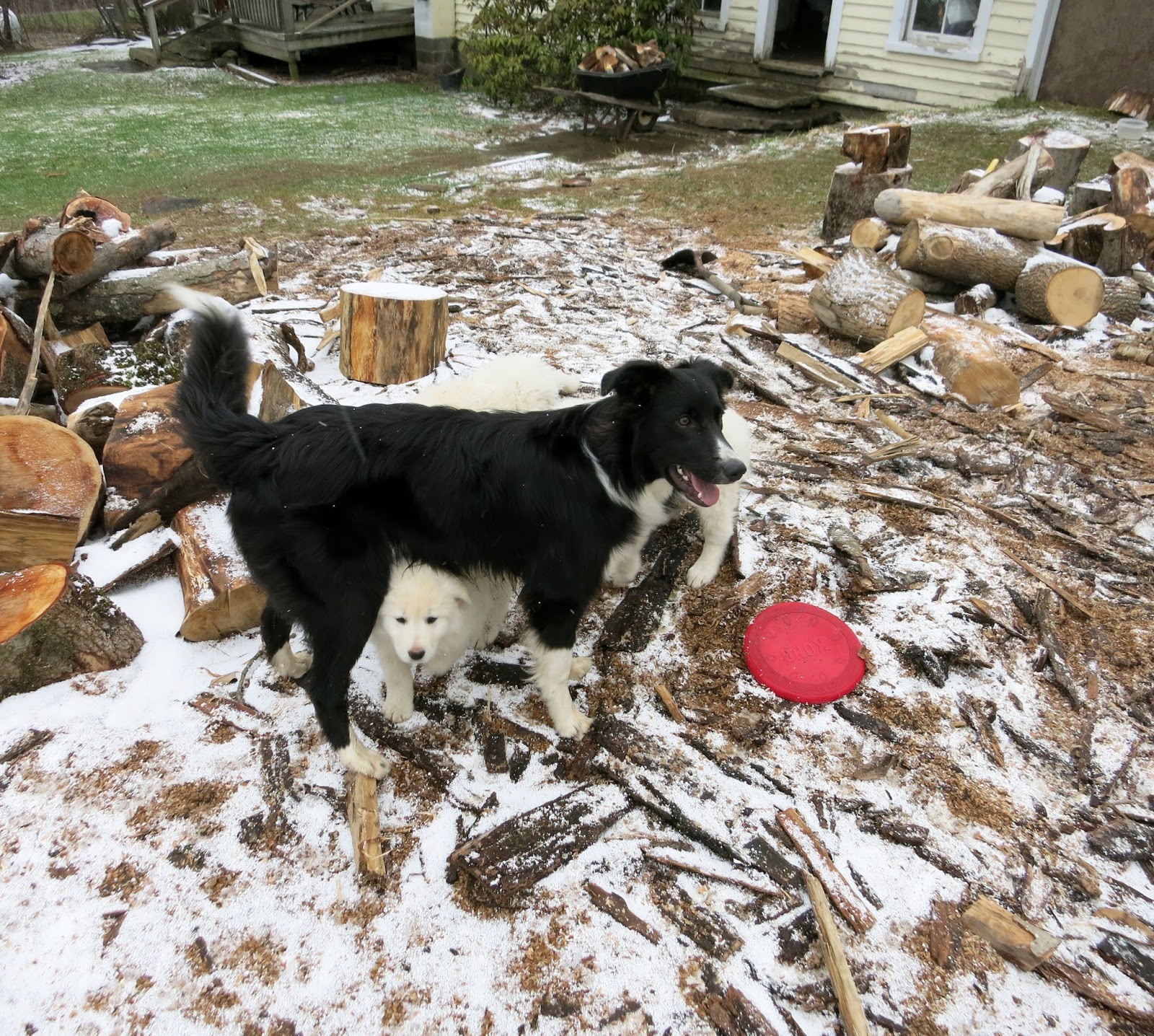
He comes up with more than enough all on his own that I really don't need to do anything other then offer praise when he gets it right. Letting him set the pace and work things out on his own is helping him to gain confidence - even if he is still a baby.

I am starting to see some signs of maturity as well as increased confidence and I think Connor will become easier to work with as he gains in both. The signs of maturity may be hard to see at times....

...but they are there. Honest.

One of Connor's most endearing traits is that he is nearly always cheerful and happy.

If I could capture and market some of his boundless joy, energy and enthusiasm we'd solve all the world's problems.

Happy Birthday to my little Con Artist. I look forward to seeing what you come up with next.
Monday, September 7, 2015
Weeding the Pond
My pond is being taken over by weeds. I tried once to stock it with catfish, which were supposed to help keep the pond clean. They did not make it through their first winter though and I haven't managed to get more yet. I've also found conflicting information about whether or not catfish really will help or not. The DEC says that Grass Carp are the way to go, but I can't get any until next Spring. Meanwhile, the darned weeds are making it tough going even for Connor and it's not a very appealing swimming hole is it?

I think the weeds may be why I have been seeing fewer and fewer turtles this year. This stuff must be awful hard for them to swim through. I read that one good way to control weeds in a pond is to just pull them out, which I discounted because it seemed like an overwhelming job. However, after the past couple of weeks of blistering heat, jumping into a weed choked pond didn't seem like such a bad idea. This afternoon, I decided to try doing a bit of water gardening.
Once I got past the minor ick factor, this turned out to be a fun job. The weeds are barely attached to anything and I was able to pull them up just by swishing my arms around in the water, it's just like twirling spaghetti. I just went out into the weeds, thrashed around and then staggered back to shore, heavily bedecked in weeds.
Too bad for all of you that there was no one around with a camera, it was probably quite a sight. Just picture an amazon sized, middle-aged, red-head in ratty shorts, tank top, hat, sneakers and life vest (because my feeble swimming skills are not up to keeping me afloat with 30 lbs of weeds wrapped around each arm) emerging from a pond liberally festooned with huge, spaghetti-twirled armloads of water weeds and you'll get the idea. If that isn't quite enough, add in the times I used the pitchfork instead - sort of like Swamp Thing meets Poseidon.
It was really quite invigorating and a heck of a water aerobics workout. Maybe I could start a new exercise fad. Who would like to join me?
I pulled out three heaping piles of water weeds. I'm thinking this might make a nice mulch on the garden.
 I'm very good at mulching gardens. Too bad I'm not so good at actually
growing things in the well-mulched garden. If I just keep adding mulch, the soil will
improve eventually right?
I'm very good at mulching gardens. Too bad I'm not so good at actually
growing things in the well-mulched garden. If I just keep adding mulch, the soil will
improve eventually right?
I stirred up a lot of silt during this process, but didn't encounter anything other than some very befuddled frogs. I do think it helped....
 At least it helped in the section of the pond I managed to cover. It turned out
to be a good use of a horribly hot day, but I do hope that I can get
some Grass Carp and maybe some more catfish in here next year and that they take over this job. I don't
think I can keep up with it. If nothing else though, Connor (and the turtles) will be able to swim safely now and we both had fun playing in the water.
At least it helped in the section of the pond I managed to cover. It turned out
to be a good use of a horribly hot day, but I do hope that I can get
some Grass Carp and maybe some more catfish in here next year and that they take over this job. I don't
think I can keep up with it. If nothing else though, Connor (and the turtles) will be able to swim safely now and we both had fun playing in the water.

I think the weeds may be why I have been seeing fewer and fewer turtles this year. This stuff must be awful hard for them to swim through. I read that one good way to control weeds in a pond is to just pull them out, which I discounted because it seemed like an overwhelming job. However, after the past couple of weeks of blistering heat, jumping into a weed choked pond didn't seem like such a bad idea. This afternoon, I decided to try doing a bit of water gardening.
Once I got past the minor ick factor, this turned out to be a fun job. The weeds are barely attached to anything and I was able to pull them up just by swishing my arms around in the water, it's just like twirling spaghetti. I just went out into the weeds, thrashed around and then staggered back to shore, heavily bedecked in weeds.
Too bad for all of you that there was no one around with a camera, it was probably quite a sight. Just picture an amazon sized, middle-aged, red-head in ratty shorts, tank top, hat, sneakers and life vest (because my feeble swimming skills are not up to keeping me afloat with 30 lbs of weeds wrapped around each arm) emerging from a pond liberally festooned with huge, spaghetti-twirled armloads of water weeds and you'll get the idea. If that isn't quite enough, add in the times I used the pitchfork instead - sort of like Swamp Thing meets Poseidon.
It was really quite invigorating and a heck of a water aerobics workout. Maybe I could start a new exercise fad. Who would like to join me?
I pulled out three heaping piles of water weeds. I'm thinking this might make a nice mulch on the garden.
 I'm very good at mulching gardens. Too bad I'm not so good at actually
growing things in the well-mulched garden. If I just keep adding mulch, the soil will
improve eventually right?
I'm very good at mulching gardens. Too bad I'm not so good at actually
growing things in the well-mulched garden. If I just keep adding mulch, the soil will
improve eventually right? I stirred up a lot of silt during this process, but didn't encounter anything other than some very befuddled frogs. I do think it helped....

Sunday, September 6, 2015
The Donkey Daze of Summer
We seem to be getting all of the hot, dry days of summer all at once. We had a whole season's worth of rain in May and June, now we are getting the whole year's worth or horribly, hot and humid. The flies are unbelievably awful and everyone is greatly appreciating their fly-masks now.

It is too hot to even play tug-o-war with them.

It's too hot for much of anything besides hanging out in the shade.

We'd all like to be out doing stuff, but standing around in a daze, hiding from the flies is about all we are managing.


It is too hot to even play tug-o-war with them.

It's too hot for much of anything besides hanging out in the shade.

We'd all like to be out doing stuff, but standing around in a daze, hiding from the flies is about all we are managing.

Thursday, September 3, 2015
A Small Misunderstanding

"Ah, I see. I'm so glad you cleared that up for me. I can't imagine how I got that wrong."


Wednesday, September 2, 2015
The Family That Eats Together.....
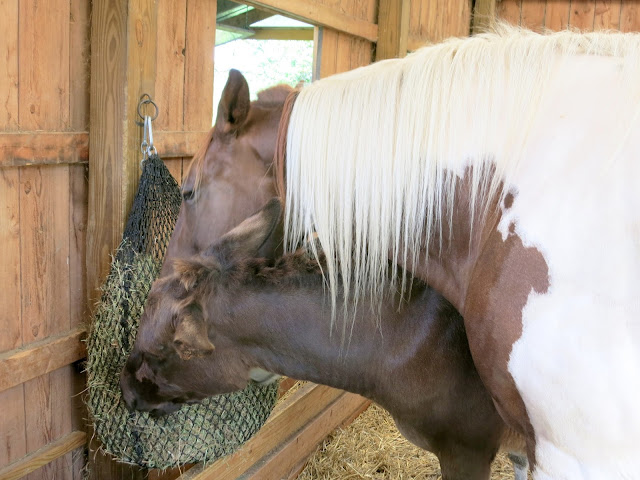
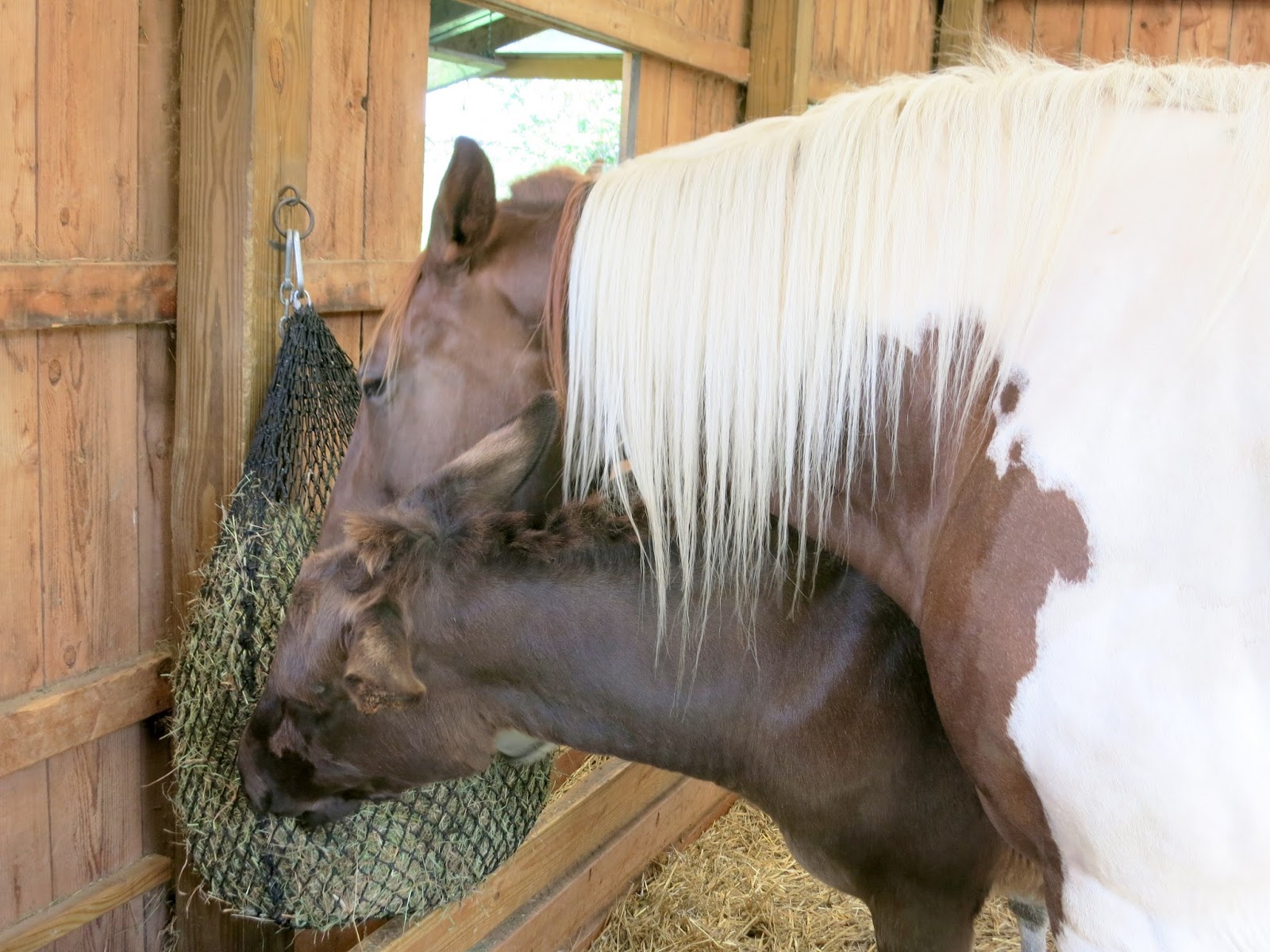
I think Tessa may be the kindest, sweetest horse I've ever known. She sure is good to her friends.






Tuesday, September 1, 2015
Mind Over Matter
"So, Emma, do you really think that staring at that gate latch is really going to make it open?"

"Of course it will, it's just a matter of willpower is all. I just know that if I stand here and stare at this gate long enough, eventually you'll get the hint and take us for a walk. Its mind-over-matter Ma, you'll see."
"Oh? And just how do you know it will work? Is this some new magic trick you've developed?"
"Don't be silly Ma, there's nothing magic about it. It's just a very simple training exercise. All I have to do is stand here, gazing longingly at the gate latch, paw the ground once in a while and occasionally bray piteously. Eventually, you won't be able to hold out a moment longer and you'll give in, the gate will open and we'll go for a walk. You humans are really quite easy to train. I just have to be clear, consistent and patient."

"See what I mean? Basic obedience training, it works every time."

"See what I mean? Basic obedience training, it works every time."
Subscribe to:
Posts (Atom)