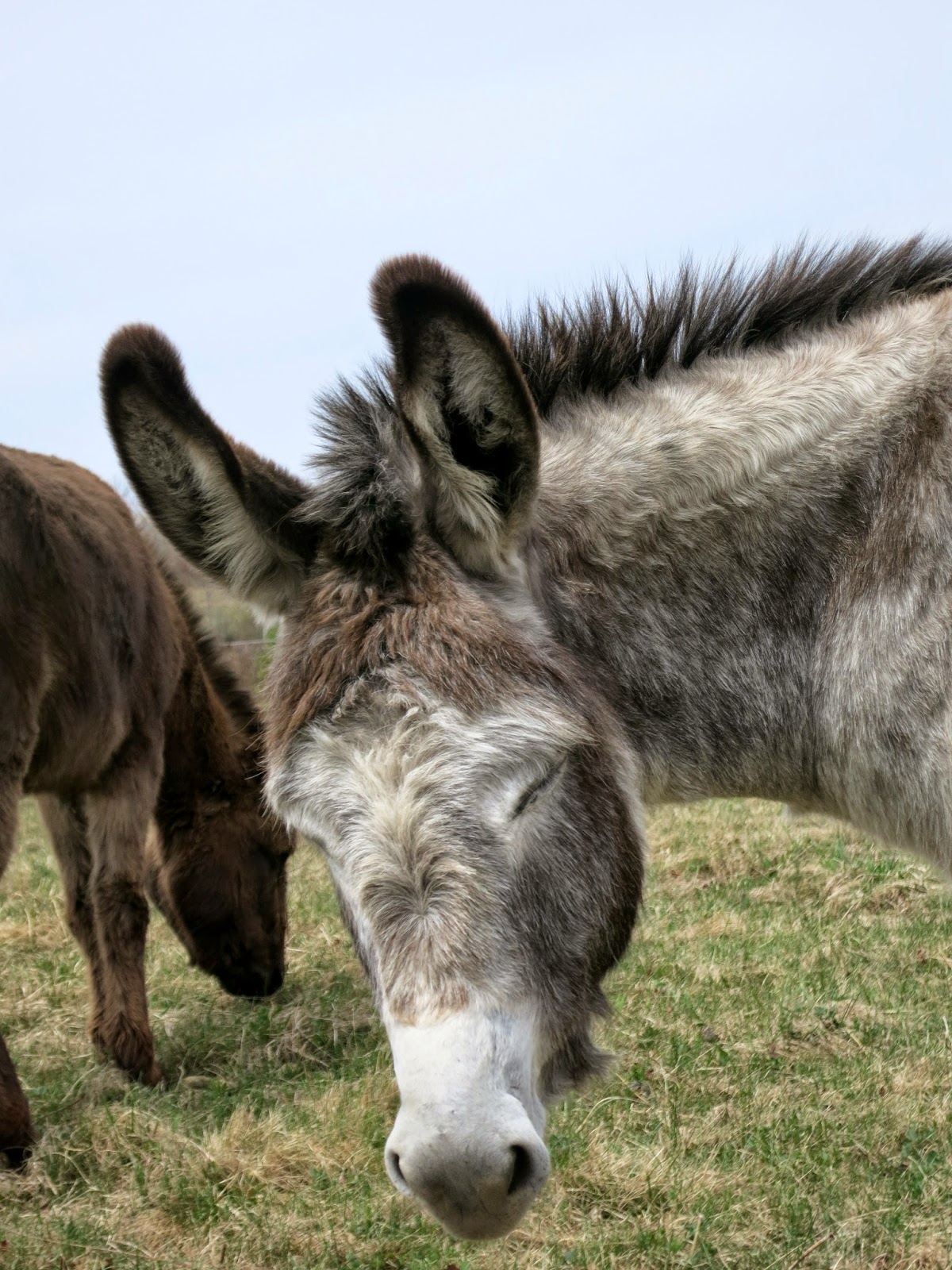
I sense a mutiny in the works and I don't think I want to know what sort of things they are whispering to each other.
Friday, May 8, 2015
Plotting Mutiny
My donkeys are very mad at me.
Ever since the beginning of April when the snow finally receded enough for them to escape the barn, they have been enjoying the run of the farm. Almost four weeks of complete freedom, unlimited grazing and daily races around the fields. They are feeling good and reveling in Spring.
Unfortunately for them, the grass is starting to grow in earnest now and that means the end of freedom. I put them back on their perimeter track which has very little grass that they have to work hard to find. They still get hay and straw, which they want no part of, especially with acres of sweet, spring yumminess surrounding them on all sides. I do feel their pain, to be be forced to eat celery and lettuce while the pizza and ice cream taunts them from every angle. It is a cruel injustice. To add injury to this mighty insult, the May flies showed up right on the first of May just to torture them. There has been much complaining.
I sense a mutiny in the works and I don't think I want to know what sort of things they are whispering to each other.
Thursday, May 7, 2015
Wednesday, May 6, 2015
Tuesday, May 5, 2015
The DE Debate
Andrea asked me if I have ever tried Diatomaceous Earth (DE) to eliminate ticks. The short answer is yes, I've tried it. Did it work on the ticks? Unfortunately, not in any way that I ever found useful. I have not ever tried to use it as a perimeter dust though. With 20 acres to cover, that is just not feasible. I rather doubt that it would work well that way, at least not in my wet/humid climate. It might be more effective in a drier region.
DE works in two ways (maybe):
Ticks are very susceptible to changes in humidity, if it is too dry they die, so DE should work well on them. However, getting enough onto the tick to be effective is the challenge that I have not been able to master.
Spreading enough DE around the property that it might help is just not doable for me. It is especially not feasible as it would get washed into the ground during the first rain. Even without rain, it would absorb so much moisture from the ground itself that it would be rendered useless within minutes. Once it is really wet, it clumps up and even its abrasiveness is rendered useless.
I have used DE to dust the animals directly as well as in chicken coops and in the garden. It works great for treating lice and mites on donkeys, horses, cattle, chickens, etc. I did not see that it helped keep ticks or flies off.
The trouble/blessing with it is that it is such a fine powder that it settles down into the hair next to the skin. That may be why it works so well for lice and mites, but ticks just crawl over the top of it. Also, I find 99% of the ticks attached under the chin, between the front legs and in the inner thighs. The DE just won't stay there. I even tried putting it into a solution and spraying it on, but it had no noticeable effect that way. I have found live ticks attached right through a layer of DE.
A couple of the the things I do not like about using DE on the animals is that it is a definite irritant to eyes and lungs and it really dries out the skin. That last can be a good thing for the donkeys when it is extremely humid as they are meant for a dry climate and are prone to fungal infections, but used routinely, it is too much.
If anyone more clever than me comes up with a successful way of using DE to control ticks, please do let me know. I would appreciate it.
***
Since I get asked about feeding DE, using it as a wormer or feed-thru fly control at least 6 or 8 times a year and we're on the subject....
When DE first started gaining popularity 12-15(?) years ago, we were all set to jump on the band wagon. It sounded like the greatest thing since sliced bread - a natural, organic pesticide, wormer, miracle cure that parasites could never develop a resistance to. And, for the external parasites I already mentioned, it is all that.
Since that time, I've learned a lot more about DE and the entire premise of using it to treat internal parasites now seems ridiculously faulty to me. The first mode of action, as a desiccant, becomes moot as soon as it hits the stomach full of fluid. As for the second mode of action...If it actually DOES work that way, I just can't see how it would be safe to feed in doses large enough to actually kill parasites. Maybe its because of my job as a histotech, but that idea just scares me. and here's why:
The photo below was taken through a microscope. It is a piece of normal small intestine
Those finger-like projections are where 90% of nutrient absorption takes place and they line the entire length of the small intestine. This tissue section is cut at 5 microns thick (remember the scale in the first photo?), to put that into perspective, a red blood cell averages about 7 microns. Lining the outer edges of those fingers are super tiny cilia that are so small they can't be seen here. If you look REALLY close at the top of this photo, you will see that the outer edge of fingers appear to have a faint, pink fuzz - that is called the brush boarder and is made of those tiny cilia. They are like little Velcro "hairs" that reach out and "grab" individual nutrients.
Remember those big, sharp diatoms in the first photo? If DE really is that abrasive, what do you suppose they might do to these tiny, delicate, crucial structures when fed in sufficient quantity to "shred" worms? The way I see it, if it is safe to feed than it is not going to kill worms through sheer abrasion. If it does kill worms that way, how can it be safe to feed?
DE is considered safe as a food additive and is used as an anti-caking agent in feeds. However, it is generally used in very small amounts in feeds that are themselves supposed to be fed in small amounts. A large enough quantity of DE to kill parasites through sheer abrasion while inside the GI tract....nope that just doesn't make sense to me.
I personally know several horses who were routinely fed DE to control worms. They all suffered for it and at least two youngsters nearly died of anemia caused by extremely heavy parasitism. To my eye, horses who have been fed "therapeutic" doses of DE for a long time have an unthrifty look to them. They often have diarrhea and their hair coats look long and dull. Whether from worms or the DE itself, I couldn't say.
My opinion, for what it's worth to you....Use DE to dust for lice. Use it to dust the bedding litter in chicken coops to kill mites. Use it in the garden to kill aphids and slugs, but don't use it to kill worms. If the propaganda gets to be too much and you absolutely MUST try it, do regular fecal egg counts and if your critter starts acting listless and lethargic, stop feeding it and call your vet ASAP.
DE works in two ways (maybe):
- It draws moisture out of anything it comes in contact with, including insects, which kills them. Once the DE is wet, it stops working.
- The second mode of action is a bit more questionable, there does not seem to be any clear consensus as to the veracity of this.....DE is made of microscopic diatoms, which have very sharp edges. This abrasiveness cuts up tiny insects and kills them. (notice the little scale at the bottom right that says 10 microns, that is about the thickness of a piece of paper. I'm going to come back to that in just a bit)
Ticks are very susceptible to changes in humidity, if it is too dry they die, so DE should work well on them. However, getting enough onto the tick to be effective is the challenge that I have not been able to master.
Spreading enough DE around the property that it might help is just not doable for me. It is especially not feasible as it would get washed into the ground during the first rain. Even without rain, it would absorb so much moisture from the ground itself that it would be rendered useless within minutes. Once it is really wet, it clumps up and even its abrasiveness is rendered useless.
I have used DE to dust the animals directly as well as in chicken coops and in the garden. It works great for treating lice and mites on donkeys, horses, cattle, chickens, etc. I did not see that it helped keep ticks or flies off.
The trouble/blessing with it is that it is such a fine powder that it settles down into the hair next to the skin. That may be why it works so well for lice and mites, but ticks just crawl over the top of it. Also, I find 99% of the ticks attached under the chin, between the front legs and in the inner thighs. The DE just won't stay there. I even tried putting it into a solution and spraying it on, but it had no noticeable effect that way. I have found live ticks attached right through a layer of DE.
A couple of the the things I do not like about using DE on the animals is that it is a definite irritant to eyes and lungs and it really dries out the skin. That last can be a good thing for the donkeys when it is extremely humid as they are meant for a dry climate and are prone to fungal infections, but used routinely, it is too much.
If anyone more clever than me comes up with a successful way of using DE to control ticks, please do let me know. I would appreciate it.
***
Since I get asked about feeding DE, using it as a wormer or feed-thru fly control at least 6 or 8 times a year and we're on the subject....
When DE first started gaining popularity 12-15(?) years ago, we were all set to jump on the band wagon. It sounded like the greatest thing since sliced bread - a natural, organic pesticide, wormer, miracle cure that parasites could never develop a resistance to. And, for the external parasites I already mentioned, it is all that.
Since that time, I've learned a lot more about DE and the entire premise of using it to treat internal parasites now seems ridiculously faulty to me. The first mode of action, as a desiccant, becomes moot as soon as it hits the stomach full of fluid. As for the second mode of action...If it actually DOES work that way, I just can't see how it would be safe to feed in doses large enough to actually kill parasites. Maybe its because of my job as a histotech, but that idea just scares me. and here's why:
The photo below was taken through a microscope. It is a piece of normal small intestine
Those finger-like projections are where 90% of nutrient absorption takes place and they line the entire length of the small intestine. This tissue section is cut at 5 microns thick (remember the scale in the first photo?), to put that into perspective, a red blood cell averages about 7 microns. Lining the outer edges of those fingers are super tiny cilia that are so small they can't be seen here. If you look REALLY close at the top of this photo, you will see that the outer edge of fingers appear to have a faint, pink fuzz - that is called the brush boarder and is made of those tiny cilia. They are like little Velcro "hairs" that reach out and "grab" individual nutrients.
Remember those big, sharp diatoms in the first photo? If DE really is that abrasive, what do you suppose they might do to these tiny, delicate, crucial structures when fed in sufficient quantity to "shred" worms? The way I see it, if it is safe to feed than it is not going to kill worms through sheer abrasion. If it does kill worms that way, how can it be safe to feed?
DE is considered safe as a food additive and is used as an anti-caking agent in feeds. However, it is generally used in very small amounts in feeds that are themselves supposed to be fed in small amounts. A large enough quantity of DE to kill parasites through sheer abrasion while inside the GI tract....nope that just doesn't make sense to me.
I personally know several horses who were routinely fed DE to control worms. They all suffered for it and at least two youngsters nearly died of anemia caused by extremely heavy parasitism. To my eye, horses who have been fed "therapeutic" doses of DE for a long time have an unthrifty look to them. They often have diarrhea and their hair coats look long and dull. Whether from worms or the DE itself, I couldn't say.
My opinion, for what it's worth to you....Use DE to dust for lice. Use it to dust the bedding litter in chicken coops to kill mites. Use it in the garden to kill aphids and slugs, but don't use it to kill worms. If the propaganda gets to be too much and you absolutely MUST try it, do regular fecal egg counts and if your critter starts acting listless and lethargic, stop feeding it and call your vet ASAP.
Monday, May 4, 2015
Resisting Temptation
Irmgard asked if I'm not just the littlest bit tempted to keep one of the maremma puppies...
Of course I am. These are very nice, sweet, fluffy, cuddly marshmallow puppies that are nearly irresistible. I don't know how anyone could possibly keep their hands off them. There was one puppy in particular who tried very hard to pick me as his human. He was the one who always ran up to me first, who liked me best and wanted to follow me home. He was also the biggest, toughest, most dominant guard dog in the whole big pack of guard dogs. At four weeks old, he liked to climb up onto the hay bales and bark and growl down at all his smaller siblings. He is going to be one BIG bruiser of a dog. He is also very sweet, smart, charming and oh-so-huggable. A big, squishy, fluffy, highly opinionated teddy bear - with attitude. He is also going to weigh around 180 pounds when he grows up.
As a joke, I started calling him Brutus the Bruiser. We laughed at him and teased him with it and all agreed that we couldn't saddle the poor fellow with that for his whole life. And then it started to stick anyway.
Did I think about it? Oh yeah, most definitely. I thought about it quite a lot actually and that is why I am not going to be bringing Brutus or any of the other puppies home. If I could, by some miracle, find a work-from-home job, I'd do it. But, I don't see that happening any time soon and a huge, fluffy, aggressive guard dog is not going to fit into my world right now.
The remaining puppies (there are five left yet) have gone back to their owner, many of them have gone on to new homes. Brutus was one of the first to go. He went to a really great home with a very nice family who have experience with Maremmas. They also have 100 acres, a job for him to do and a great deal of love. He will do well there.
The other, bigger reason not to bring a Maremma pup home is Connor.
Connor has not been the easiest puppy to raise, but he is becoming an excellent dog. He is ultra high energy, easily distracted and fiercely intelligent. He is one of the most complex dogs I have ever known, but that is very easy to miss in his boundless energy and enthusiasm. It took me a long time to figure out what motivates him and how to use it once I had. He likes food, but would leave a steak dinner to play with a dish towel. He figured out clicker training within minutes and was bored with it nearly as fast - he will walk off and find a way to amuse himself rather than play clicker games.
Connor's real motivation is engagement and play. He desperately wants to be part of everything and he will work very hard to find a way to insert himself into any task. I am just now figuring out how to work with that. I also have to watch out for him and make sure he takes occasional breaks because there is just no quit in this dog. He responds best to subtle, nonverbal cues that allow him to work through a problem on his own and find a solution. If he gets it right, I praise him lavishly and spend several minutes playing with him. Anything he learns this way, he gets 100% without fail and he willingly builds off of these skills. Anything I try to make him learn with more traditional methods or clicker training, is a battle I never reliably win. He is always trying to find the loopholes just for the sake of figuring them out.
The remaining puppies (there are five left yet) have gone back to their owner, many of them have gone on to new homes. Brutus was one of the first to go. He went to a really great home with a very nice family who have experience with Maremmas. They also have 100 acres, a job for him to do and a great deal of love. He will do well there.
The other, bigger reason not to bring a Maremma pup home is Connor.
Connor has not been the easiest puppy to raise, but he is becoming an excellent dog. He is ultra high energy, easily distracted and fiercely intelligent. He is one of the most complex dogs I have ever known, but that is very easy to miss in his boundless energy and enthusiasm. It took me a long time to figure out what motivates him and how to use it once I had. He likes food, but would leave a steak dinner to play with a dish towel. He figured out clicker training within minutes and was bored with it nearly as fast - he will walk off and find a way to amuse himself rather than play clicker games.
Connor's real motivation is engagement and play. He desperately wants to be part of everything and he will work very hard to find a way to insert himself into any task. I am just now figuring out how to work with that. I also have to watch out for him and make sure he takes occasional breaks because there is just no quit in this dog. He responds best to subtle, nonverbal cues that allow him to work through a problem on his own and find a solution. If he gets it right, I praise him lavishly and spend several minutes playing with him. Anything he learns this way, he gets 100% without fail and he willingly builds off of these skills. Anything I try to make him learn with more traditional methods or clicker training, is a battle I never reliably win. He is always trying to find the loopholes just for the sake of figuring them out.
When he is home with me, Connor has become just about the best farm dog you could ever hope for. He is quiet and respectful around the donkeys, he responds to commands instantly and is unfailingly cheerful and eager to go. He is always with me, but not in the way. He never wanders and he has a clear understanding of boundaries. He sees everything, takes it in and learns from it. It sometimes takes me a while to figure out exactly what he is learning, but eventually, he ends up teaching me about it. It's almost always a surprise when I figure it out.
When Connor is around other dogs, all of that disappears in a wild flurry of play and pack dynamics. Right now, I think Connor has the best of both worlds. He has time and space to grow, study, learn and develop when he is home with me. When he goes to Farm Buddy's (nearly every day) he gets to be one of the pack. I think the combination is very good for him and he would not have that if I brought in another puppy.
Connor has grown so fast and looks so grown up that it is easy to forget that he is still just a puppy himself. He will be 8 months old at the end of this week, which is a hard age for a dog. It's puberty, adolescence and early adulthood all in one. I may get another dog at some point in the future when Connor has matured more. Right now though, I think my complicated little land shark still needs all the attention I can give him and I am enjoying watching his mind work. I feel like I am just beginning to figure out what makes him tick and how his very busy brain works. I don't want to lose that.
Besides, Connor has got enough to deal with playing big brother to both Maggie and Bess. It's a very tough job....
When Connor is around other dogs, all of that disappears in a wild flurry of play and pack dynamics. Right now, I think Connor has the best of both worlds. He has time and space to grow, study, learn and develop when he is home with me. When he goes to Farm Buddy's (nearly every day) he gets to be one of the pack. I think the combination is very good for him and he would not have that if I brought in another puppy.
Connor has grown so fast and looks so grown up that it is easy to forget that he is still just a puppy himself. He will be 8 months old at the end of this week, which is a hard age for a dog. It's puberty, adolescence and early adulthood all in one. I may get another dog at some point in the future when Connor has matured more. Right now though, I think my complicated little land shark still needs all the attention I can give him and I am enjoying watching his mind work. I feel like I am just beginning to figure out what makes him tick and how his very busy brain works. I don't want to lose that.
Besides, Connor has got enough to deal with playing big brother to both Maggie and Bess. It's a very tough job....
Friday, May 1, 2015
The Spring Rush
I really am working on several blog posts answering some of the questions I've gotten recently. There's also lots of goings on...lambs being born, puppies here, there and everywhere, trees, gardens, miserable chaos at work....It's been a crazy week. I will try to get caught up this weekend.
In the mean time how about some more puppy pictures. These are from last weekend with Maggie and Connor. I meant to send them to RB, but I may as well send them to everybody because you can never have too many puppy pictures right? Right?!
Maggie, 8 1/2 weeks old....
In the mean time how about some more puppy pictures. These are from last weekend with Maggie and Connor. I meant to send them to RB, but I may as well send them to everybody because you can never have too many puppy pictures right? Right?!
Maggie, 8 1/2 weeks old....
Subscribe to:
Posts (Atom)