Wednesday, April 24, 2013

A True Sign of Spring

The future is looking good for some wild-blueberry/rhubarb jam.  Yum!  My Favorite.

Tuesday, April 23, 2013

Lakota

OK, you asked for it so here goes...:)

Lakota is a 15 year old paint gelding who is some relation of Gabe's (Lakota's mother was Gabe's grandmother I think.  Does anyone know what that relation is called?).  He was born on RB's farm and has been with her ever since.  He has had foot troubles pretty much from the start.  His troubles probably started with either a genetic predisposition towards long toes or, much more likely, he had a low pastern angle when born as many foals do, they generally grow out of it within a few weeks.  Since Lakota's feet are quite soft, they may have started to wear poorly right from birth.  Proper trimming at a very early age would have corrected this, but left unchecked by his farrier, it set him up for a lifetime of trouble.

RB was fairly new to horses at the time of Lakota's birth and did what any extremely caring and conscientious horse owner would do, she trusted her vet and farrier to know and do the right thing.  That is what we pay them for after all.  What I have found is that many of the vets don't really know much about farrier work and that the farriers in this area are fairly competent as long as they are starting out with a healthy foot, but they don't know how to recognize early signs of trouble and can't deal with any sort of deviation or problem.  All of the vets and all the farriers who have seen Lakota throughout his life (and there have been more than a few) have pretty much said the same thing, "it's just the way he is".

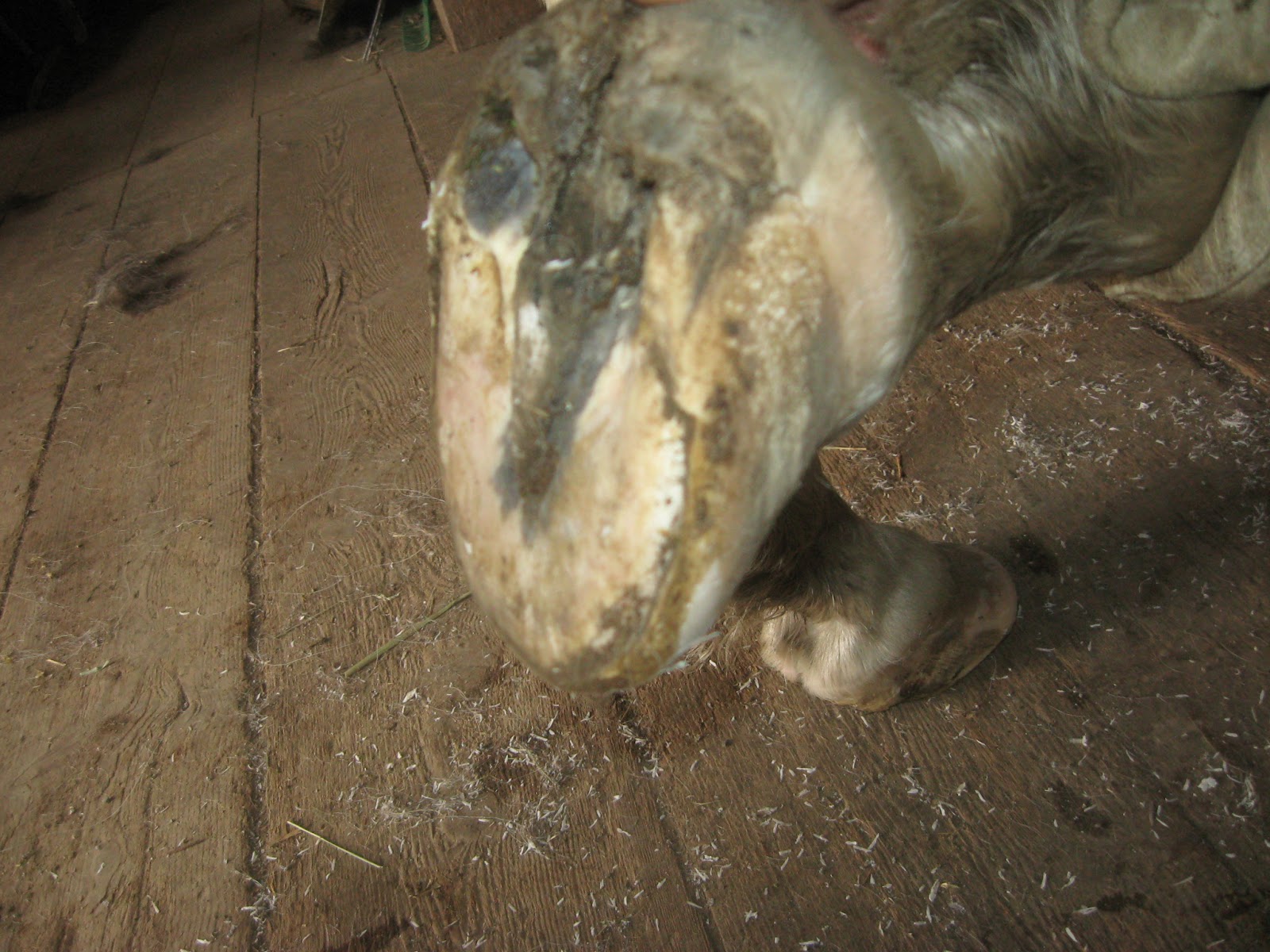
Looking at these feet I was not sure that they were wrong.  These were taken 1/4/13.

These poor things look like they should be on a Platypus, not a horse.

Here is the worst part...His soles have nearly a 1/4 inch of convexity and absolutly no wall support.  If you look close, you will notice a slight pink tinge to the entire bottom of the foot, that is from bruising.

Here is the foot with more of my line drawings.  Again, the blue lines are where the foot is now.  In particular, look at the blue line at his heel, that line is longer than his toe.  It should be about a 1/4 the length of the toe. Also, look at where that line ends at "2", his heel is actually in front of his leg.  The white lines show where a healthy foot would be.  The lines at "1" and "3" should be parallel to each other and his heel should line up with the back of the leg, not the front.  

Most farriers look at this foot and say, "the toe is too long and the heel is too low".  They have, several times, "fixed" this foot by cutting the toe way back and putting shoes with wedge pads in the heel to raise the heel up and shorten the toe.   Doing that makes Lakota immediately sound - for a little while.  The problem is that the shoes and pads do nothing to treat the underlying problem and in fact, make it worse because the whole time they are on, the heels just keep growing farther and farther forward and getting more and more crushed.  When the shoes finally come off, poor Lakota is so lame he can barely walk.

The misunderstanding between heel height and heel length is, in my opinion, the absolute, number one cause of trimming problems in horses.  In the above picture, it looks like Lakota's heels are only about a 1/2 inch off the ground, but if you measure the actual hoof wall tubules, his heels are nearly 3 inches long.  If his heels really were a 1/2 inch long, this would be a very different, very healthy foot.  Correcting those heels is my main goal at this point.

Here is where we were at on 3/31/13.  I didn't draw any lines here, but you can use the stripes on his feet instead, they will tell the story.

After I trimmed the feet above, I put on a set of equicasts to give Lakota some support, pain relief and to help stimulate growth.

We left the casts on for 3 weeks and I pulled them off on 4/20/13.  We are going to wait a week and then, possibly, put a new set on.  They are an amazing product that all horse owners should know about.

If you look very closely at the coronet band (where the hoof meets the hair line) you will see that from the hair to about a 1/2 inch down, the foot is growing in at a totally new, more upright angle.  That is the foot we want and that 1/2 inch is incredibly encouraging to me.  It is the very first sign I have ever seen on this horse of healthy hoof growth.  The foot on 4/20/13...

...with more of my lines....this is very much a work-in-progress, but compare this to where we were on 1/4/13.  Especially note that the blue heel line is now almost an inch behind his leg bone instead of in front of it.

I am trimming Lakota every 3 weeks for now as I did with Hawkeye for many months.  We have extended Hawkey's trim interval to every 4 weeks, and if he gets to a healthy-hoof point, we may be able to extend that again to every 6-8 weeks.  One of the really crucial things I have learned is that, extremely fast hoof growth in any one area is a sign of a serious problem.  A healthy foot will grow evenly all the way around, will wear evenly and can go much longer between trims.

The last time Lakota had shoes put on, they desperately needed to be reset after only 2 weeks rather than the normal 6-8.  Anything that gets trimmed and then seems to sprout back in just a week or two needs to be reevaluated.  Nowadays, when I hear horse owners say to me, "my horse's feet grow super fast and need to be trimmed every few weeks", I see big red warning signs.  There is something wrong there.

As I said, this is a work-in-progress.  There is a long way to go and I am not certain that Lakota will ever have totally healthy hooves.  At 15, I am not sure just how much his feet can really change.  I am encouraged by what I see so far.  It is going to be an interesting journey.

As there seems to be a lot of real interest in the subject and I find it helpful to me to write it all out, I will continue to post updates and some other thoughts on hoof trimming as we go, donkeys included.  Their feet really are very different from a horse's feet and need to be treated differently.  Stay tuned for more fun and excitement in the world of hooves.  But don't worry, there will be lots of silly donkey stories, pictures and conversations as well.:)  Diversity is a good thing after all.

Monday, April 22, 2013

Foot Work

For any of you who are interested in my adventures with hoof trimming....you may remember that I have mentioned (click here and here)working on riding Buddy's horses, Hawkeye, Lakota and Izolde.  Poor Hawkey has been having severe hoof problems for several years now, longer than I have known him in fact.  There is no one thing that I can point at and say "this is where things went wrong".  His troubles are the culmination of a lifetime of poor farrier work, most of it prior to Riding Buddy owning this horse.  When his feet really fell apart, they did so pretty spectacularly.

When my horses, who had always had good feet prior to my move to my current location, also started having similar trouble, I began studying, researching and studying some more.  I eventually took over doing all of my own farrier work.  It wasn't something I ever thought I would do (so little ever is!), it was self defense.  More out of desperation then anything else, I started working on Hawkeye as well.  After all, I couldn't possibly do a worse job then the professionals already had.  RB and I were having serious discussions about the possibility of euthanasia being in Hawkeye's near future and that folks, would have been a crying shame.  He is some nice horse and incredibly fun to ride.

I have been working on Hawkeye for about 9 months now and those months have been plagued by self-doubt and uncertainty.  We have seen a lot of improvement in the past few months, but I was starting to wonder if I had really made that much difference.  And here is where I am very glad of the few photos I have taken of his feet.  I was rather lackadaisical and careless about it, but I know I will do better in future.  Because, when I finally went back through those photos this weekend, I can see that we have made more progress than I thought.  

This photo was taken a few months after I started working on Hawkeye.  Believe it not, this foot is actually better then what is was the year before.

This photo of the bottom of his foot shows a bit better what some of the problems were.  Take note of the crevices on the left and right side of the hoof.  Those crevices were more than an inch deep.  Hawkeye had already had a radical hoof-wall resection done, it had grown out and the white-line disease was worse than ever.  It is hard to see because of the camera angle, but the bottom of his foot is actually convex.  There should be about a half inch of concavity in the middle of his foot.  Poor Hawkeye was walking purely on the sole of his foot and the hoof walls, which should be supporting him, did not touch the ground.  He had badly contracted heels and a deep seated infection in the sulcus of the heel (that's the deep crevice in the back of his foot).

Here is some of what the problem is: (please bear with my feeble attempts at computer drawing)

The blue lines show the way the hoof tubules were growing, notice how they all curve forward and the line at the back of the foot is almost as long as the one at the toe and it is crushed forward.  The white lines are a vague approximation of what the foot should look like.
The white line labeled "2" shows the angle that the foot is trying to grow.  The line at "1" shows how long, wide and straight the heel should be.  The white line at "3" shows approximately where the toe would be if the foot were growing properly. 

This next photo is what the foot looks like as of April 13th....

Here is the same photo with more of my white and blue lines.  The blue lines are where the hoof is right now and the white is where it will hopefully be in a couple more months.  Notice especially how much shorter and more upright the blue lines at the heel are and how much less of a gap there is between the blue and white line at the toe.  We have come a long, long way.

From the bottom...all of the crevices are gone.  Gone completely! No amount of treating these feet with resection or soaking in White Lightening, CleanTrax, sugar-dine, you-name-it, helped.  Once we started trimming for healthy growth, the white-line disease went away on its own.  Also, his heels, which were so severely contracted have spread nearly an inch farther apart.....   

and, he now has a 1/4 inch of concavity with solid hoof wall holding him up.

The thing that gets to me the most though, can't be photographed.  When I first met Hawkeye, I thought he was a rather aloof, stand-offish sort.  He did not engage and always seemed rather withdrawn and uninterested.  He was hard to catch and for several months after I started working on his feet, he would actively avoid me.  Now, he is a different horse.  He is friendly, charming and enjoys interaction.  It made me realize that he has never been aloof or stand-offish, he has been in pain and now he isn't.

I will be taking more photographs of feet from now on because I really needed to see these and I needed to write it all out.  It helps give me the courage to keep at this.

If you folks out there are not bored to death yet and are interested in more hoof studies, I will share what I am doing with Lakota.  He is, believe it or not, an even tougher case than Hawkeye.  Let me know.:)

Sunday, April 21, 2013

Random Revue

It's been a busy weekend.  Dinner with friends (twice no less!), foot trimming, riding, shoveling, hiking, unexpected visitors...It may not feel like it, but it must be Spring.  My couch is calling to me and I realized recently that I have only gotten to actually sit on my couch a handful of times since last Fall.  We are due an hour or two of quality time.  Meanwhile, please enjoy a random assortment of Spring farm photos....


Ramsey's first chestnut, thin as tissue paper...


Meeting of the Boy's Club.

I can't wait to try my new swimming pool...

Tanner can't either.


Sunday Stills - Something hot

This one was tough since it has, once again, been cold and wet.  We had a brief warm day early in the week and Tanner got hot enough to want to lay in the creek a bit.  When summer comes round, I always make sure to hike near water so he can cool off.  He does not like the heat and really suffers from it.  I have toyed with the idea of shaving him as my vet suggested, but I have never quite summoned the courage.  Maybe this year.


The only thing really hot other than the wood-stove (which did not photograph well), that I could find was my kitchen stove.  

I tried.


Thursday, April 18, 2013

A Shadow's Footprint

I thought this was kind of an interesting thing.  I am sure this must happen regularly, but I have never noticed it before....Do you see the tree shape in the ice here...

With the crazy briefly warm/super cold weather we have had, at some point the sun reflected back off the ice on the pond.  At the same time the shadow was darker colored so it absorbed some of the sun and melted faster than the white ice...

leaving a lovely tree-footprint in the snow.

I think it is also interesting that, because of the angles and sun position (that is my guess anyway), this is the only tree in the pond that made a footprint.  I hope I am not the only one who thinks this is really cool:)  There has to be some silver lining to Mother Nature's crazy fickleness after all.

Wednesday, April 17, 2013

An Allergy Sufferer's Guide to Spring Horse Grooming

Part 1.  The Problem:

Part 2. Protective Apparel 

Part 3.  Choosing the Right Tool For the Job.

Part 4.  Effective Utilization of Tools

Part 5. Optional Accessories 

Part 6.  Getting Out the Big Guns*

Part 7.  The End Result - clean horses in the mud

*For anyone wondering, this is why I love my grooming vacuum.... 
I very rarely actually replace the bag in my horse vacuum, I just empty the bag between horses.  The above pile was one 5 minute vacuuming of Tessa, the cleaner one.