Showing posts with label Easyshoes. Show all posts

Tuesday, October 25, 2016

The Enchanted Forest

I haven't talked much about Levi yet.  He came to this farm about two years ago in very poor condition.  That has changed and he is in excellent shape now.

Levi has a sweet and mischievous nature and would be happy to go looking for trouble if he thought he could get away with it.  He'll test the boundaries just because he thinks he should, but he gives up happily enough because his heart isn't really in it.  He and his person have worked out a fine friendship and have a genuine connection.

This is what his feet looked like on 8/28/16 when I first looked at them....

These shoes had been reset just a couple of weeks before and you can see that they sure weren't doing much for him.   Levi was very sore and tender footed in these shoes and they were doing more harm than good.

Unfortunately, I did not get any more pictures at the time, but Levi's feet are, sadly, very typical of what I see around here.  The foot is badly under-run, he has central sulcus thrush, the walls are long with very poor connection and his soles are paper thin.

If I had remembered to take pictures of those soles, you would have seen that the bottom of his foot was nearly convex rather than concave and the frog was prolapsed beyond the bottom of the sole.  I know that if we had had x-rays taken, they would have shown a sole with only 3-4 mm of depth rather than the 15-20 he should have.

This is very common in this area because the ground is perpetually wet and soft.  The soil is highly acidic and very deficient in both copper and zinc, which are needed to grow good feet.  Feet like this are a by-product of our environment and the extent of the associated problems depends on the genetics of the individual horse.  I have seen much worse than Levi, but there is a great deal of room for improvement.

As a side note, I think I have posted this article before, but it is worth revisiting if you live on soggy ground:  http://www.thehorse.com/articles/15097/managing-wet-feet

My goals with Levi are to treat the thrush, bring the heels back and shorten the toes.  This should allow him to grow in healthier, well connected walls, which will also increase the depth of his soles.

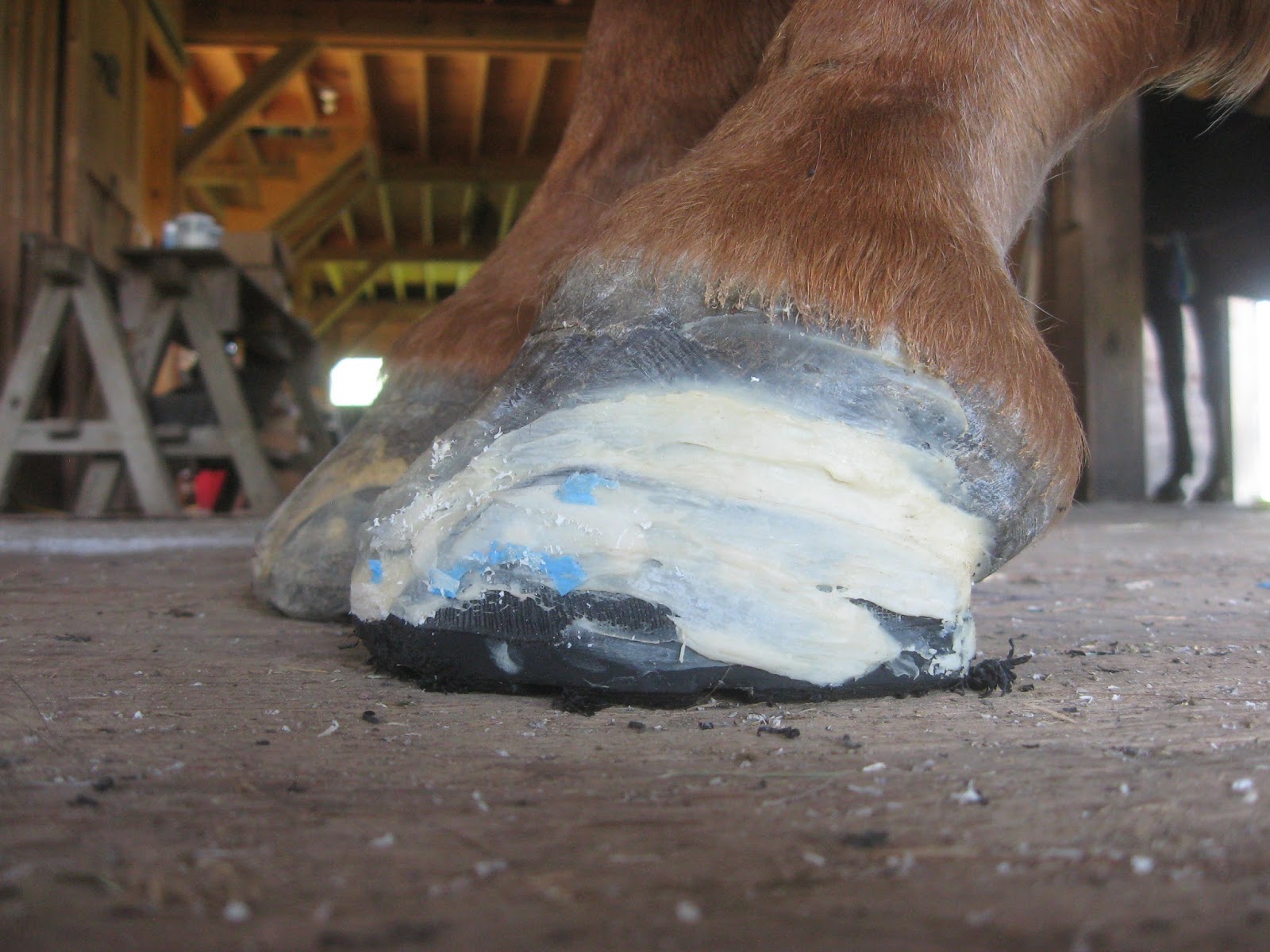
This is what his foot looked like on Friday after I had pulled his first set of Easyshoes....

Believe it or not, this is improvement. When we started, Levi's collateral groove at the back of his foot was less than a 1/4 inch deep and was a negative number at the front of the frog.  Here, he has about 1/2 an inch in the back and 1/8 at the front.  Dismal, but still an improvement.

I was worried about Levi when I did his feet the first time because his feet were so flat, I was afraid that even the Easyshoes would put too much pressure on his thin soles.  Thankfully, the Easyshoes made him immediately more comfortable instead and he is striding out well in them.

As you can see in the above photo, he also has very thin hoof walls.  I find it a bit tricky to clinch the nails without ripping them right through the walls.

I have been using copper-clad nails, which just came on the market a few months ago.  I really like the copper because nail holes are generally a great breeding ground for bacteria and the copper prevents that.  The copper nails are a little harder to use though as they are a bit less malleable.  So far, I think the trade off is worth it and my clinches will get prettier with more practice (and thicker hoof walls).  The shoes stay on - knock-on-wood.

I could have made the feet look prettier by rasping off more of the excess toe, but that would be cosmetic and do nothing other than thin the walls even more.  I have set the shoe back far enough that the break-over is where it would be if this were a healthy foot.  Doing that will help him actually grow a healthy foot.  I prefer to leave the feet a bit ugly, but functional rather than pretty and sore.  Levi doesn't mind and his opinion is the only one I really worry about.

I got an email from Levi's person telling me they went out driving down the gravel roads of the state land with his new shoes.  It is the first time they have been able to do that this season because this is the first time his feet were not sore on the tough gravel of the Enchanted Forest.

That is what I like to hear.

***

I have had a couple of requests for an update on Ben's foot and I am working on that.  I will try to have it ready in the next few days.

Monday, September 26, 2016

Famous Amos - part two

I know everyone wanted pictures of Amos, but you will have to wait a few weeks.  This is the only photo I remembered to take and, as you can see, Amos was on a mission.  That is Levi to the left.

I do have some pictures of Amos' feet though.  This is what they looked like when I met him....

8/28/16

These shoes were reset just a couple of week before this photo was taken and you can see how long and distorted this hoof is.  This is fairly typical of a horse who has been shod his entire life.  The foot is long with weak heels, the toes are too long and the back of the foot is poorly developed.

Here is the other hoof after I had pulled the shoes....

After pulling the shoes, I did not touch the feet.  We left Amos barefoot and left the feet long so that he could wear them down naturally.  If I had trimmed them right off, I would most likely have made him sore.  I wanted his feet to wear down and toughen up naturally.

This photo was taken on 9/16/16.  I know it is a crappy photo, but you can still see that the foot is much shorter and already getting stronger.  If you compare with the above, you will see that the nail holes that were about an inch above the ground are nearly gone in this shot....

This was taken on 8/28/16 just after the shoe was pulled.  Notice how overgrown the hoof looks and how atrophied, narrow and poor the frog is....

Same view on 9/16/16, you can see that the foot has already widened a bit....

8/28/16  These next photos are, perhaps, the most telling set.  The heels and the frog should be at the same level.

You can see how much excess height the foot has and how the frog will never touch the ground.  This frog is terribly weak and contracted.  There is also a bad thrush infection in the central sulcus.  That crevice in the back should not exist, yet it is over and inch deep.  The sulcus thrush causes a lot of damage to the back of the foot and is very painful.  I can make this horse flinch just by pushing on this area with my thumb, imagine what walking on it would feel like.

9/16/16  This is what just a couple of weeks of no shoes has done for Amos....

It was at this point that Dave called me and told me that Amos was getting to be tender-footed and ouchy on stones, which came as no surprise.  The excess hoof had worn away and that weak, painful frog was finally starting to touch the ground.  This is a good thing as the frog cannot heal and grow without stimulation.  However, we did not want Amos to become lame and we did not want him to have to stop working.  Exercise is the best thing for these feet, but not if it makes him sore.

This is the Catch-22 conundrum of transitioning a horse from shoes to barefoot, especially an older horse who has never had the chance to properly develop the back of the hoof.  That frog is too weak to support the horse, yet the frog needs to work in order to grow healthy.  It has already improved with the added blood-flow provided by being barefoot and Dave has been diligently treating the thrush, which has also improved a great deal.

This is where shoes usually come in.  Most people would have shoes put on which would raise that frog off the ground and temporarily alleviate the pain.  The foot would grow taller and narrower, pinching the frog and making it sore so he would need new shoes and the foot would grow taller and narrower....eventually we would be right back where we started with that long, weak foot we saw in the first photo.

In order to break this cycle and still keep Amos sound, we opted to try Easyshoes on Amos and Levi.  The shoes offer most of the same benefits as the hoof boots without the hassle and frustrations of hoof boots.  Unlike steel shoes, the Easyshoes are flexible and allow the hoof to expand and contract as it should while also providing sole and frog stimulation.  They should encourage the frog to continue to develop while protecting it at the same time.  They are a good choice for transitioning a horse to barefoot.

9/16/16

We hope that Amos will be able to go happily barefoot at some point.  I believe that he has inherently decent feet that will improve given the chance.  However, there is always the question of how much the inner structures of the hooves can improve in a horse at this age.  Given the progress Amos made in just a couple of weeks out of shoes though, I think he stands a good chance of growing a healthy bare foot.


Sunday, January 31, 2016

The Saga - Part 2

Before I go on with part two of Hawkeye's tale, I need to back up to summer of 2014.  We had been watching for the release of a new type of plastic/rubber horseshoe that we had been hoping might work out for Lakota.  We had a pair on order for him, unfortunately, he had a major, incurable crisis just days before those new shoes arrived in the mail and we had to let him go. 

Because of Lakota, we had been dabbling with the EasyShoes (which are basically like sneakers for horses) and wanted to try them out more even though he was gone.  They are very flexible in all directions and provide most of the benefits of going barefoot, while still offering protection.

The shoes are somewhat similar to the Easyboots that RB had been using on Hawkeye for several years.  The boots work well most of the time, but do sometimes fall off, don't always fit perfectly and can be a bit of a hassle.  We liked the idea of the Easyshoes because they seemed like they might offer the benefits of going barefoot with the protection and convenience of a shoe.  We wanted to see if they would work.

This is one of the shoes just slipped on the hoof to check for fit...

Easycare offers a "fit-kit" for a nominal price.  Basically, you measure the hoof to find the closet size and then they will send you samples of that size plus one smaller and one larger size.  I definitely recommend doing this if you are going to try these shoes.

The Easyshoes come in several versions and we chose the Easyshoe Performance.  We liked this shoe because it provides support and stimulation to the whole hoof, including the frog, rather than just the outer walls.  This shoe comes in either a glue-on only version or one that can be glued or nailed.  Initially, we wanted to use these as a glue-on shoe.

We tried them out on both Tessa and Hawkeye with so-so results.  There are several types of glue used for these shoes, all of which are two-part urethane/cyano-acrilate type things that are very expensive and totally unforgiving.  In my normal obsessive way, I did tons of research and learned way more than I ever really wanted to about glue.  The two most common glues used with these shoes are Adhere, a urethane glue and EasyShoe Bond, the cyano-acrilate glue.  The latter is considered to be the better choice for wet environments, so that is what we tried.

The trouble with these glues is that they have a very steep learning curve and the tiniest misstep ruins the glue along with the shoe you are trying to glue on.  That wouldn't be a big issue except that, at $65 per tube of glue plus $45 per pair for shoes, that learning curve can add up to a LOT of money in a very short time.

The gluing process requires extensive prep and extreme attention to detail (Easycare has several excellent videos on their webpage detailing how to put these on and I strongly recommend them for anyone interested in the shoes). I wasn't put off by the process, because attention to detail is one of my strengths.

The hoof has to be totally clean, prepped for glue and DRY.  That last was a huge hurdle for us given that our pasture conditions are wet in the best of times and it rained incessantly that summer.  We used a moisture meter and small butane torch to get the hoof wall dry, but moisture still ended up being our biggest problem.  A wet environment causes the hoof to swell and then contract when it dries.  Since the pasture is wet and the barn is dry, we have a constant wet/dry cycle that is a challenge to any adhesive.

Temperature is also a huge factor in dealing with the glue.  It does not like to be either too hot or too cold, nor dose it like excess humidity.  It was about 85 degrees with 95% humidity when we did this and the glue did not like that at all (neither did we).  We kept the glue in a cooler until we were ready to use it, but that first tube of glue we used had gotten very hot in transit before it got to us.  It had the consistency of cottage cheese when it came out of the tube and did not get us off to a good start.

This was my second ever attempt at glue-on shoes, after Hawkeye pulled one off after the first week.  The other shoe stayed on 4-5 weeks if I remember right.  It's not pretty, but they did work. 

In addition to the shoe, I added "Blue Stuff", as we call it.  It is Dental Impression Material.  It is another two-part material that sets up when mixed.  Unlike the glue, this stuff comes in tubs and is rather fun to play with.  It has two components that are just like silly putty, you mix them together and squish the stuff into whatever shape or crevice you want.  It will set up into a flexible, cushiony silicone pad that gives the foot more support and stimulation.

Despite the rain, mud and humidity, we did have some success with the glue-ons.  After some trial and error, replacing the first tube of over-heated glue and much persistence, I was getting pretty good at gluing on shoes.  However, with Lakota gone, we didn't need them so much, the cost and prep time were rather onerous and the boots we had been using for years still worked.  We ultimately gave up on the glue-on shoes.

I think there is a real place for glue-ons and I am glad to have had some experience with them.  I am not convinced, though, that they are a good option in the kind of wet environment we have.  That doesn't mean that they aren't a good product and I would try them again if the circumstances warranted it.  I do think that the price of glue needs to come way down for this to be truly viable for the average horse owner.

***

I have to add here that I do have some personal pet peeves about the glue, or the marketing of it I should say, that really got under my skin.  It is extra costly and difficult to experiment with the glue because each type of glue requires its very own dispensing gun, which won't work for any other type of glue.  At $75-100 per gun, that can add up fast.  The glue we chose can be used without a gun (which is what we did), but it definitely adds to the difficulty in an already difficult process.

The guns are basically fancy caulk guns, but they are purposely designed to lock you into buying only the glue that fits that gun. This kind of marketing scheme just bugs me and turns me off the products.  If any one of these companies ever develops a gun that works with all the different glue cartridges now on the market, I would immediately become a loyal and devoted costumer.  Better yet (and easier) would be to make the glue cartridges work with a regular caulk gun, which I already have or can buy at any hardware store.

Some manufacturers do offer some small, single-use tubes that you can use without a gun.  However, "single-use" is optimistic.  They are such a huge pain in the a** to use that they end up being more of a waste than a help.  Fighting with those suckers could easily drive a saint into a fit of rage. 

If you are a professional farrier who is going to be charging $200-500 for a set of these shoes, then spending $500 to gain proficiency and another $500 to stock up on glue and dispensing guns is a good investment and that extra $100 bucks is no big deal.  For me and RB, the cost of glue-on was a hard pill to swallow.

Despite my annoyance with the manufacturers of these products, I am also very glad that they are there.  There are so many more (and better) options for helping horses with foot problems now than there used to be thanks to companies like EasyCare and Vettec.  Glue-on shoes are only a small, recent part of what they offer and those are only just beginning to come into their own.  The glue-ons have come a long way from where they were  a few years ago and I expect that they will continue to improve and adapt in the coming years.

***
Since the glue on shoes weren't quite right for us, that left the other option in EasyShoes.

To be continued....


Friday, January 29, 2016

A Long Saga

I've been meaning to write about Hawkeye for ages now.  Long time readers will remember that he is Riding Buddy's horse and he has had issues with his feet for many years.  He has a long history of white line disease, hoof-wall separation, thin soles, long toes and severely contracted heels.  He is also highly sensitive to sugar an we treat him as insulin resistant.

The first year that I worked on his feet, we saw huge improvement.  Although we never did get the really robust foot we hoped for, he did grow in a comparatively healthy foot with good wall connection and decent sole depth.  He was sound in the pasture, but still needed hoof boots for riding on stony ground, which is about the best you can hope given the soil conditions in the area..  He was in good shape given where he had started and the limitations we have to work with.

The environment that hawkeye lives in is incurably wet, stony and extremely acidic.  It is basically an old bog filled in with rocks and it is a very tough, hostile place for hooves despite the effort and care RB puts into it. There is only so much that can be done to improve the fundamental geology of the place so we work with what we have.  There is pea gravel outside the barn, copious drainage ditches and a beautiful, immaculate barn.  Despite the environmental issues, Hawkeye went form being chronically sore, aloof and unhappy to sound, outgoing and content.

Last year, all that fell apart.

It started as a very subtle thing.  The first I remember noticing, is saying to RB that Hawkeye seemed withdrawn and unhappy again.  He never showed any specific lameness, but I could always see pain and tension in his carriage and affect.  Sometimes it seemed like his knees, other times, I swore it was in his hip.  And, every day, his feet got a little worse.  No matter what I did, the toes got longer, the soles thinner and the white line disintegrated to the point that he could barely walk.

We scratched our heads, tweaked his already tightly controlled and balanced diet, studied his gait and added up his years -we came up with more than we had thought - Hawkeye is about 20 years old.  We figured arthritis was getting the best of him and started having very bleak discussions about quality of life.  Hawkeye retired and RB went out and bought a new horse (which is a whole other story).

Every time I saw Hawkeye though, something nagged at me about him.  It just didn't add up.  Twenty isn't all that old and I could just see that something wasn't right. I didn't know what it was at the time, but I could feel the wrongness.  Finally, last Fall, he was tested for Lyme disease and he was off-the-charts positive.  We finally had an answer to everything and all of his vague, shifting symptoms suddenly made a lot of sense.

I had long suspected that Lyme disease could have been a problem, but there is so much controversy and misinformation about it, that, up until the past couple of years, when it has reached epidemic stage in this area, it was difficult to get any kind of diagnosis.  Even with a diagnosis, most vets used to be reluctant to treat it.  Many horses test positive without showing signs (or the signs go unnoticed or are misinterpreted) so it used to be considered not worth treating.  Lyme tends to fall into a Catch 22 type of hole, many of the subtle symptoms of Lyme go unnoticed until the horse is treated and because the symptoms go unnoticed, they don't ever get treatment. 

Hawkeye was our first definitive encounter with Lyme Disease.  He is why I knew to take action when I saw the same subtle wrongness in my herd this past Spring.  In retrospect, I strongly suspect that Lakota probably suffered from chronic Lyme.  His vague, but devastating symptoms were similar.

Hawkeye was put on 4 days of I.V. Oxytetracycline followed by 30 days of Minocycline, which is now considered to be THE drug of choice for treating Lyme in horses.  We chose Minocycline because Doxycycline was not available at the time.  However, since then, it has proven to be much more effective than the doxy, with a 100% cure rate - so far.

According to several veterinary sources, Minocycline is the better choice because it passes through the blood-brain barrier. The hardest part of treating Lyme is that the spirochetes which cause the disease burrow into tissues where neither antibiotics nor the body's own immune system cannot reach.  It is this nasty little fact that makes Lyme so difficult to treat and also why it causes such diverse symptoms.  In an attempt rid itself of the disease, the victims own body turns against itself, often causing symptoms that mimic autoimmune diseases.  Some researchers believe that "chronic Lyme" is actually an autoimmune problem triggered by Lyme.  The most successful treatment options are to either use multiple, pulsed doses of antibiotic or use a drug that can reach more areas of the body, such as Minocycline.

Treatment helped Hawkeye immensely, but it wasn't the immediate cure for his feet that we would have liked because no amount of antibiotics can regrow a healthy hoof for him.  His feet had degraded to the point that he was stuck in another sort of Catch 22, negative feedback loop.

His feet hurt so he did not move well.  Exercise and normal movement are what is needed to stimulate healthy hoof growth, but his feet hurt so he didn't move.  Added to that, he does have some genuine osteoarthritis issues, aside from the lameness and muscle soreness caused by Lyme.  His sore feet made the arthritis worse, which made him reluctant to move, which made his feet worse, which made the arthritis worse.........  We needed a way to break the cycle, and that is where my experiments with Easyshoes that I did last year come in.

To be continued....