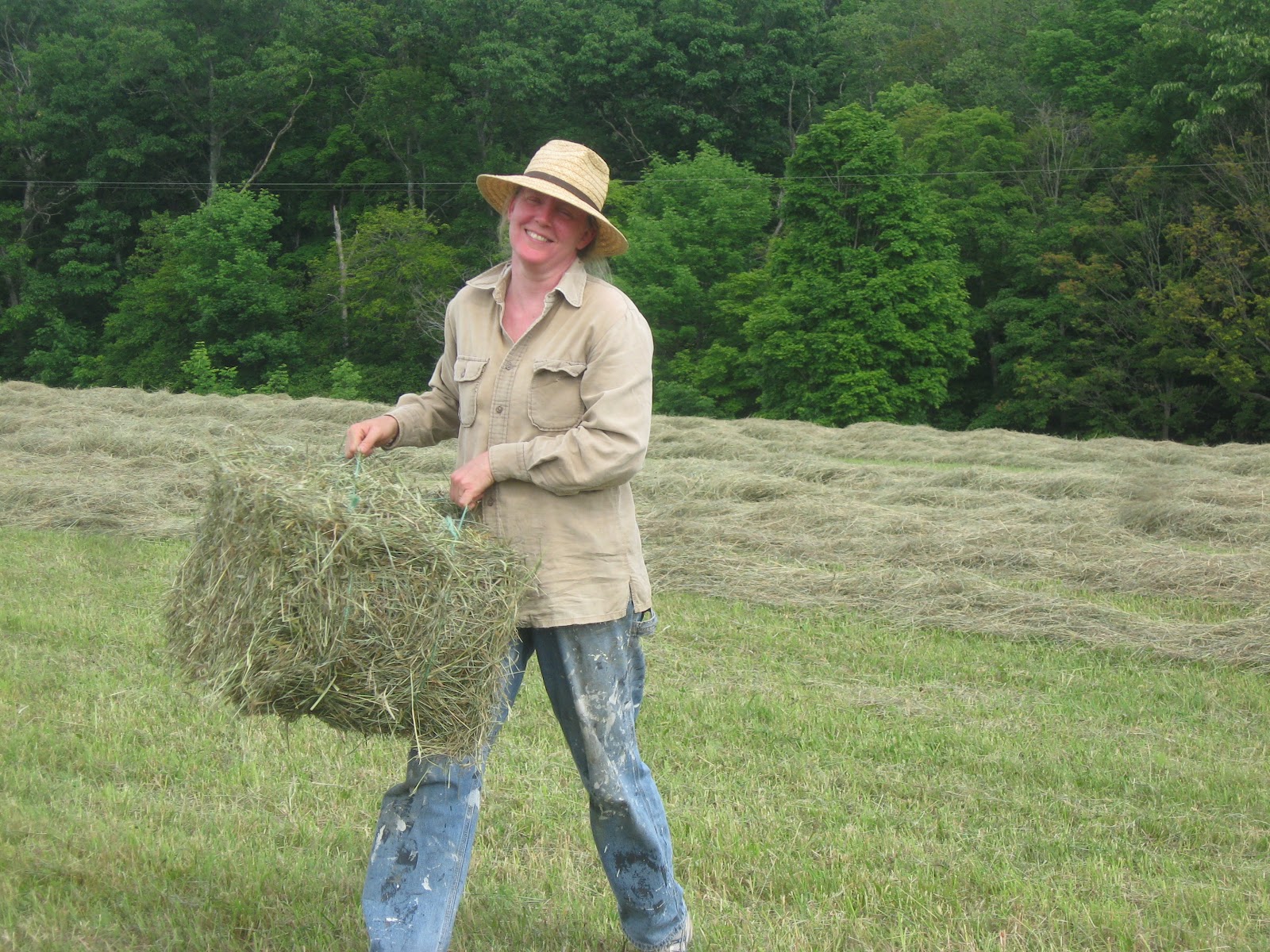
This week's Sunday Stills challenge was historic sites or monuments. Since we were making hay this week, I initially thought that I would probably end up skipping this challenge. I got to thinking about it though and, really, what could possibly be more historic than making hay on an old farm (built around 1870) in what was once, long ago a thriving community. The few farms still struggling to survive in an area that was once all working farmland are the best historical sites I can think of for a tiny upstate hamlet barely holding onto existence.
Making hay is one of the truest, most universal cornerstones of all human society. It's the making and storing of feed so that our farms can survive, so that we can survive. However, in our ever more urbanized culture, many people don't seem to realize that this is still one of the most crucial aspects of keeping our world fed. Gone are the days when a barn full of hay is what guaranteed that our workforce, livelihood and transportation survived the winter....
or ensured that we would have clothing to wear....
but it is still the the lifeblood of any farm, very literally the difference between life and death (not to mention the continued survival and happiness of our beloved donkeys and horses as well).
We have been extraordinarily lucky the past couple of years to have the help an incredible group of friends who have taken time out of their own very busy lives to come together to help us put our hay in.
It is a hot, exhausting, dirty job demanding extreme, prolonged physical effort. In years past, it has often been just Farm Buddy and I doing this job ourselves, with only the occasional bit of help coming our way. Doing the job as we did this time, with a group of fun, intelligent, hard workers along with the best four days of hay weather we've ever had made the job into a pleasure rather than a trial, as it so often can be.
We must have racked up some really good hay karma somewhere along the way for this batch of hay. We had been getting worried as the weather was being impossible for so long. We normally average about 2.5 inches of rain in the month of June. This year, by June 15 we had had almost 10 inches and the specter of flooding was growing. It is always better to have a wet year than a dry one, as last year proved (because of the drought last year,
this same patch of ground produced half the number of bales it did yesterday), but there are limits.
We were even luckier this time because Riding Buddy's mother, who is
world-class chef, made a feast for all of us at the end of the day. It
is hard to describe just how great it is to come in at the end of a hay
day to find that someone else has done the cooking. That is a luxury we have never known before, but we sure could get used to that in a hurry!
Through a complicated barter deal with a nearby dairy farm, we make three kinds of hay here; baleage, dry round bales and the small square bales pictured above. The last are all made with Farm Buddy's ancient, but (mostly) functional equipment, half of which was designed to be pulled with horses. The neighbor farm does all of our mowing, round bales and baleage.
The modern round baler gobbles up hay at an amazing rate...
rolls it up tight, wraps it in plastic netting, spits it out....
and goes on gobbling. And if you're wondering why we don't have our own equipment like this, it's because just these two pieces represent about $50,000. Add in the tedder, rake, bale wrapper...The mind boggles.
A couple of weeks ago they made 45 balages. This week we put in 842 square bales and 6 dry round bales. The next time we have dry weather, we'll be doing it all again. We wouldn't want anybody going hungry around here after all.