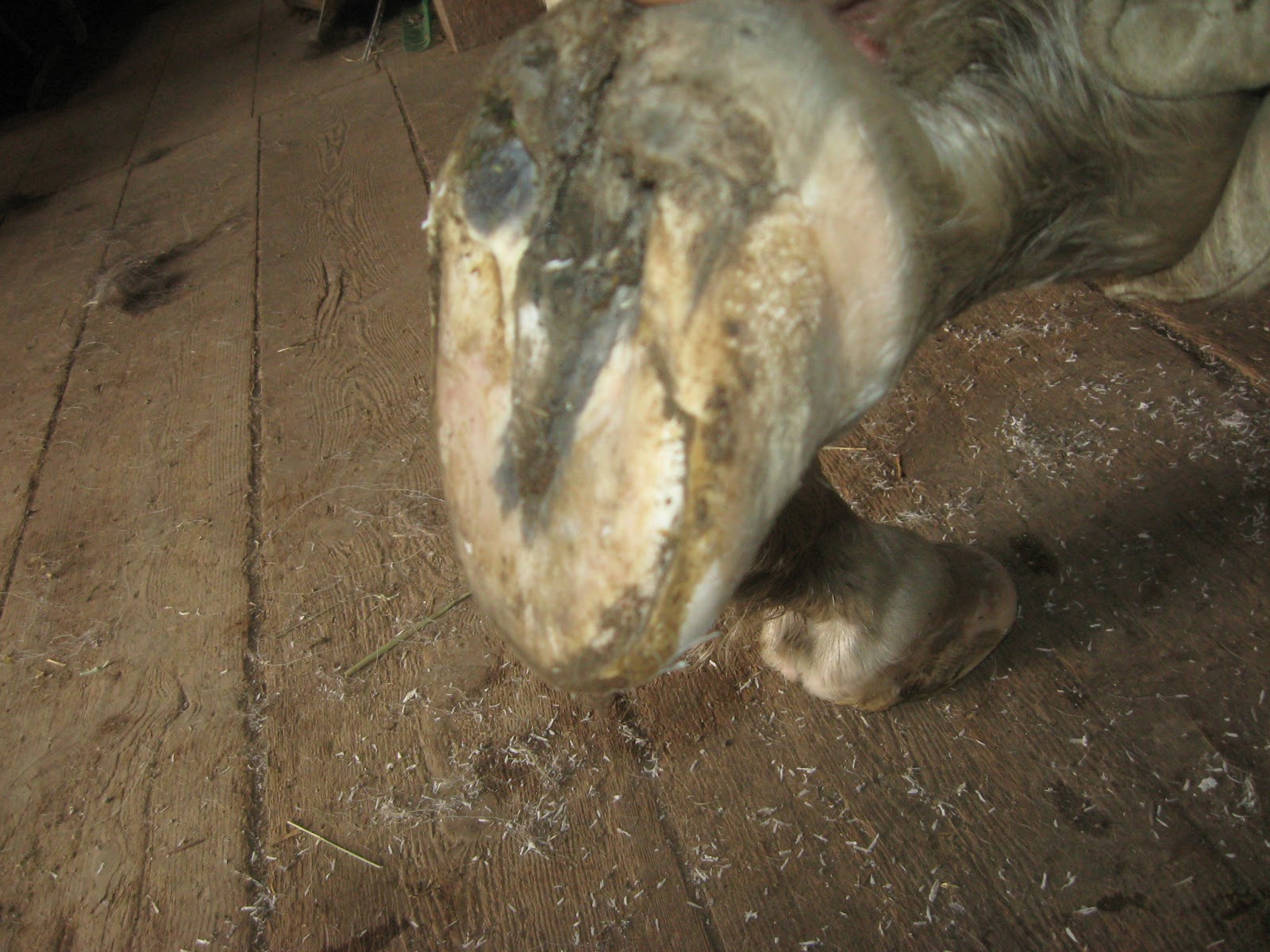
I haven't had an update about Lakota in a while and that's mostly because we have been on a real roller coaster ride with him for the past couple of months. He had been doing tremendously well this Spring and Riding Buddy was even able to ride him very lightly again.
Then he got an abscess, a very bad abscess. We have no idea what caused it. It blew out the back of his heel and he lost over half of the the sole and wall in his lateral heel, which amounted to half of his main support system in that foot. He recovered, although never quite 100%. It was growing in, but very, very slowly.
Despite this, he was nearly back to being riding sound again by the beginning of June. Then the ground dried out for the first time in at least 18 months and became hard as granite. Even though he was wearing padded boots or casts at all times, he was fairly uncomfortable on anything but the softest ground.
We noticed some other changes in Lakota this Spring as well. He took a very long time to shed out. He has been urinating copiously and with great frequency. His feet have been getting sore and then better for no apparent reason. He has been on a rigidly controlled, low-sugar diet, but still having recurring hoof problems. All are symptoms of cushings disease.
I made some changes, gave him even more padded support, tried to get him up off his soles. He was always better after I worked on his feet than he was before, my cardinal rule. RB had a truckload of pea-gravel brought in to give him a soft, comfy area to hang out in and let his feet wear naturally. He got better again. He was moving around with the herd, doing well, nearly sound.
We've been paying close attention to a new product called Easyshoes and have a pair on order for him, they're on back-order. I put a pair of them on Hawkeye (RB's other horse) about 10 days ago to see how they worked. Good so far. We thought they might be just the thing for Lakota and had hoped to try them out next week when they finally get here.
Two days ago, he came up severely lame with another abscess in the same foot that abscessed earlier. I went down and packed the foot with Magic Cushion and an icthammol poultice. Yesterday, he was a bit better. I had a bad feeling about it though. I was very worried about his other foot, what had always been his weaker foot. It was going to have to take all his weight until the abscess broke. I was concerned that the stress might cause him to founder on that foot despite his soft bed and added protections. Unfortunately, I was right.
By this morning, Lakota had foundered severely on his "good" foot as well as being severely lame in the other. His back feet had strong pulses and were also sore from trying to compensate. He had spent most of the previous 12 hours laying down. The vet was out this morning, gave him a thorough exam and we hashed out every possible avenue of treatment we could think of. Lakota never got up for any of it. There really was only one possible outcome.
We all made the final call unanimously and we gave Lakota the last, greatest, hardest gift there is to give. The gift that only we can give. The gift that might be the true mark of humanity.
Few horses get to live out their entire lives with a single loving, caring, conscientious owner. Lakota was one of the lucky few who got to spend every day of his 16 years as if it were his birthday. He has never known a hard word or a hungry night.
Lakota had a huge a vivid personality and the bond between him and RB was clear and palpable. He leaves behind a very big hole in the world.
Goodbye Lakota, Mr. Crazy Blue Eyes, I know you have perfect feet now and are running like the wind. Or playing soccer with a feed dish, that's far more likely.
Showing posts with label lakota. Show all posts
Thursday, July 10, 2014
Saturday, April 19, 2014
Forward, backward, onward
- Distal descent of P3 (otherwise known as a sunken coffin bone).
- Badly flared and poorly connected hoof walls.
- Severely under-run heels.
- Runaway toes.
- Contracted heels.
- Six degrees of coffin bone rotation.
- A poorly developed, weak and diseased frog.
- A deep and persistent central sulcus infection.
- A severe mineral imbalance and life-long deficiencies of key nutrients.
- A coffin bone showing damage and remodeling caused by constant pressure and bruising.
- And, only 2 mm of sole protecting the bottom of that coffin bone from the outside world.
I took over care of Lakota's feet out of desperation. Every farrier who had worked on him to that point had generally made things worse for him. They did not mean to, but I don't believe they recognized all the different, yet intertwined, problems going on with this horse. Each one focused on just one aspect of his feet and assumed the rest would take care of itself. Riding Buddy and I have taken a very holistic approach to all of the foot problems we had been struggling with and made changes in diet, management, environment....everything. I worked on his feet all summer, trimming them every two weeks and, by Fall, we had made significant progress.
10/27/13 Still troubled, but sounder than he ever had been....
Unfortunately, not long after the above picture was taken, Lakota broke through a fence and gorged himself on windfall apples causing an episode of laminitis. About a month later, he got out on a pasture that still had a significant amount of grass under the snow cover and had another episode (don't ever assume that winter grass is safe for a highly sensitive horse or donkey). Last month, Lakota came up severely lame with a bad sub-solar abscess that set us back even further. He was finally sound enough (barely) for me to work on his feet again about three weeks ago.
On a much more positive note, he had a new set of x-rays taken about the same time and, despite all the setbacks, Lakota now has 10 mm of sole depth. That may not sound like much, and it is still terribly thin, but it is 5 times what he had last year.
3/30/14 before trim. You can see that the front of the hoof wall, which had nearly become straight in the Fall, once again has a slight dish to it, caused by his back to back bouts of laminitis.
3/30/14 after trim. It's not all bad. Despite the setbacks, this is still a MUCH stronger hoof now than it was one year ago. The heels are dramatically improved, much less under-run and de-contracted. He has a relatively healthy frog, it is still somewhat weak, but all signs of disease and infection are gone. The bars are no longer folded over on themselves and, he has 10 mm of sole.
One of the most difficult aspects of correcting all these issues is that the hoof gets stuck in a kind of endless negative feedback loop. The walls need to be trimmed way back, especially at the toe, in order to get healthy connection and sole growth. However, with such thin soles, those overgrown walls are all that he has to support him. The soles won't grow because all the energy of the foot is going into growing excess wall, the walls can't be controlled because they are all that is protecting the soles. Round and round it goes. Unless something can be done to break out of this loop, it will never end. That is where Lakota has been stuck for the past 15 years.
This is where the casts and dental impression material come in. The dental mold provides support, cushion and stimulation that the sole needs...
The casts (hot pink was on sale - 1/2 off!) provide even more support and protection as well as stabilizing the entire hoof capsule while still allowing for expansion and contraction. These are what gained us that hard won sole depth. We're hopping for more.
The most interesting thing to come out of Lakota's recent bouts with laminitis can be seen in the photo below, taken mid trim.
We horse people tend to think of laminitis in a rather limited, one-dimensional fashion. We generally focus on the toe and think in terms of rotation of the coffin bone. This isn't really accurate though. The coffin bone is the anchor for the entire hoof capsule, it is the planetary core that the crust is attached to. No matter how severe the laminitis, it is not the coffin bone that moves downward, even when we think of it as puncturing the bottom of the foot. The coffin bone can't move, it is joined to the bone above it (P2) and that joint does not fail during a bout of laminitis. Rather, it is the hoof capsule that loses its attachment to its anchor and rotates upwards, affecting every part of the foot - not just at the toe, but the quarters, heels, sole - everywhere.
In this photo, you can see a butterfly-shaped pattern of "bruising" right in the center of the hoof, on either side of the frog. This is not bruising from an external source, it is the damage that was caused to the lamina of the sole during a minor laminitic episode. It has taken this long for it to grow out enough to be visible, both front feet look exactly the same. It is clearly visible here because there is so little pigmentation in the foot...not something you'll see every day (thank God).
That lack of pigmentation is interesting in itself. Lakota does have very white feet, however, constant pressure and bruising to the bottom of the coffin bone can cause the sole to lose pigmentation as well, similar to the way a scar will grow in white on dark colored horse.
Note: I did not trim anything from this sole, only used my knife to scrape away the dirt so that I could really see what was going on. The line drawn in front of the apex of the frog is approximately where the white line should be (hopefully, will be someday). The short line just in front of that is where I brought his toe back to in this trim. This may look scary, but most of that toe is lamellar wedge, the hoof's version of overgrown scar tissue that needs to be removed.
Lakota was sore when I started, but walked off much sounder after his trim and has improved since. I'm happy to have been able to stick with one of my cardinal rules of hoof trimming - the horse should be at least as sound after the trim as he was before.
Wednesday, December 4, 2013
One step Forward, Two....
Been a while since I updated any of the feet posts. Here is where Lakota was 6/7/13...
and where we were 10/27/13
The photo above is showing some really great progress. The dramatically shorter toe, lower heel, tighter connection and straighter hair line are all great. Unfortunately, about the time these were taken, Lakota managed to break through the fence separating him from a massive trove of windfall apples and he came up rather ouchy with warm feet and strong digital pulses. All not-so-great things.
As a result, I think we lost a bit of ground, not a lot because we got on top of it very quickly, but the tiny sliver of concavity in his sole disappeared. Here is where he was 12/21/13...
In spite of that, there is some positive news to share. We have made some significant changes to all of the horse's diet in the form of a custom mixed mineral supplement that I have put together and we have seen dramatic improvements in just a few weeks. I think you can see it in the top 3/4 of an inch. There is some nice growth showing there that began almost to the day of the nutrition changes.
In my last update, I also mentioned using dental impression mold to stimulate frog growth and it sure does work. If you look at the two photos below, you can see what I mean. The photo on the left shows a very weak, thrushy, diseased frog that is painful to thumb pressure. Amazingly, it is actually a significant improvement compared to what it was back in April. These poor quality, painful frogs have been plaguing all of the horses and are at the heart of nearly all the hoof problems we are dealing with. They are one of the main reasons I have been working on nutrition so obsessively. The only way to have healthy frogs is to grow a healthy frog. The only way to do that is through diet and proper stimulation. Which is where the dental impression molding comes in. I hope that you can see that the frog on the right is much improved. It still has a looong way to go, but it is much stronger as is the entire back half of the foot.
7/20/13 10/27/13

12/21/13 I think that if we can ever get that very deep crevice at the back of the foot to grow in, we will finally start seeing a much more functional foot. Healthy movement is what grows a healthy foot.
and where we were 10/27/13
The photo above is showing some really great progress. The dramatically shorter toe, lower heel, tighter connection and straighter hair line are all great. Unfortunately, about the time these were taken, Lakota managed to break through the fence separating him from a massive trove of windfall apples and he came up rather ouchy with warm feet and strong digital pulses. All not-so-great things.
As a result, I think we lost a bit of ground, not a lot because we got on top of it very quickly, but the tiny sliver of concavity in his sole disappeared. Here is where he was 12/21/13...
In spite of that, there is some positive news to share. We have made some significant changes to all of the horse's diet in the form of a custom mixed mineral supplement that I have put together and we have seen dramatic improvements in just a few weeks. I think you can see it in the top 3/4 of an inch. There is some nice growth showing there that began almost to the day of the nutrition changes.
In my last update, I also mentioned using dental impression mold to stimulate frog growth and it sure does work. If you look at the two photos below, you can see what I mean. The photo on the left shows a very weak, thrushy, diseased frog that is painful to thumb pressure. Amazingly, it is actually a significant improvement compared to what it was back in April. These poor quality, painful frogs have been plaguing all of the horses and are at the heart of nearly all the hoof problems we are dealing with. They are one of the main reasons I have been working on nutrition so obsessively. The only way to have healthy frogs is to grow a healthy frog. The only way to do that is through diet and proper stimulation. Which is where the dental impression molding comes in. I hope that you can see that the frog on the right is much improved. It still has a looong way to go, but it is much stronger as is the entire back half of the foot.
7/20/13 10/27/13
12/21/13 I think that if we can ever get that very deep crevice at the back of the foot to grow in, we will finally start seeing a much more functional foot. Healthy movement is what grows a healthy foot.
Monday, September 23, 2013
Lakota - Making Progress
Lakota's feet are one of the reasons I have been delving into equine nutrition so deeply lately and have had all of our hay and pastures tested. While many people would say that his sunken coffin bones are the result of founder, I know that this horse has never suffered an acute laminitic episode. He has been tested for IR and he is negative, nor does he show any signs or symptoms of IR while Hawkeye does. Lakota's feet have slowly, steadily gotten this way over time and the alarming aspect of this is that I have seen the beginnings of such symptoms in every horse who has lived on either of our properties for more than a few months, which is why I suspect a nutritional or environmental issue as one of the initial causes of his troubles. There are a lot of factors at play here, but that may have been the pebble that started the avalanche.
I have the hay test results and one of the glaring issues is the balance between the trace minerals. The ideal ratio of trace minerals is generally considered to be 4:1:4:4 iron:copper:zinc:manganese. I don't have the numbers in front of me, but when I did the math, my pasture ratio was in the vicinity of 20:1:5:55. We have added a high copper/zinc supplement, which has helped, but it is still way off. I am working on creating a custom mix, but I still need more information. The levels of manganese in all of our samples were higher than the highest range in the entire Equi-Analytical database and I have not yet been able to determine a safe way of balancing this. I am still working on it and when I get things figured out more, I will post some of the results and what I am doing about them.
In the mean time, I am still working on the trimming aspect of Lakota's feet and we are making some progress there. About 8 weeks ago, after the x-rays, I started trimming and wrapping Lakota's feet every two weeks and it is fianlly starting to pay off. Before that we were seeing some tiny improvements, but mostly just maintaining the status-qua.
I have been looking for ways to stimulate better growth and improve circulation, especially in the back of the foot, which was so horribly weak. This first photo was taken 4/20/13 and shows what I mean. The frog is so badly atrophied and diseased that the heel bulbs are actually growing down and under the foot in an attempt to protect the sensitive tissue underneath. Combined with the paper-thin soles and disconnected walls, it's really amazing that this horse could walk.
In these next two photos, you can see that we are finally making some real progress. The one on the left was taken 9/9/13 and the right taken 9/21/13. On 9/9 we decided to try a product called Magic Cushion made by Absorbine. It is a hoof packing material with antibiotic/microbial properties, it sort of feels like putty mixed with tar. I packed it into the entire bottom of the foot and put the casts over it. Two weeks later there are some good things happening along with a few things I am not sure are good or not. The things I really like are that the heels and frogs have widened considerably. In fact the entire hoof has gotten wider and shorter. If you look closely at the distance between the apex of the frog and the tip of the toe, you can see that the distance has shortened by about a quarter of an inch. The overall width of the foot from side to side has gained nearly half an inch as has the back of the frog, all of which is excellent. This was the very first time the the heel buttresses (which are right about where my thumb disappears) had not folded forward on themselves and had instead widened.
This softening of the sole was good and very helpful for the moment, but I would not like to see it any more soft. I like what the Magic Cushion did, but I wouldn't use it continuously, at least not under the casts in these conditions. Because of that and because I want to really support and stimulate the back half of the foot, we decided to try this:
This is an impression mold material. It is the same stuff that dentists use to create molds of teeth. Each part has the consistency and feel of silly putty, when they are mixed together the stuff begins to set up into a soft, squishy solid that retains its shape. I think it is some kind of silicone epoxy, but I don't know anything about how it is made. It is fun to play with though and I can already think of several different applications that I want to try. That will take a bit of contrapting though and I need to think about it more. If my ideas work out, I'll share them some time. But I digress, back to feet...
A custom fitted, cushioned orthotic, the toe area is cut out to help remove any pressure from the tip of the poor, abused coffin bone.
Below is the trimmed foot, with its blue cushion and ready for a new set of wraps, check out how much flatter the hair line is and how much shorter the whole foot looks. Also look at where the heel tubules end now (they hit the floor just behind where the light colored trimmed portion ends), if you can remember back a few months, they used to be so long they were actually in front of the leg. Now they are just behind the leg, still too far forward, but better...
The next morning, the phone rang while I was in the shower. I could hear RB's voice leaving me a message, but couldn't make out the words. Because it's the way my mind works, I immmediatly started imagining that she was calling to tell me that her horse was lame and I'd done something terrible to him. I came out a few minutes later and listened to the message with some trepidation....
"Kris, I just had to call and let you know that Lakota is out here running and bucking and kicking in a way I haven't seen in...in...in...a long, long, long time. In AGES! He hasn't stopped running in the last half hour..."
That's a good way to start the day. I can't wait to see what these feet look like in two weeks.
Tuesday, April 23, 2013
Lakota
OK, you asked for it so here goes...:)
Lakota is a 15 year old paint gelding who is some relation of Gabe's (Lakota's mother was Gabe's grandmother I think. Does anyone know what that relation is called?). He was born on RB's farm and has been with her ever since. He has had foot troubles pretty much from the start. His troubles probably started with either a genetic predisposition towards long toes or, much more likely, he had a low pastern angle when born as many foals do, they generally grow out of it within a few weeks. Since Lakota's feet are quite soft, they may have started to wear poorly right from birth. Proper trimming at a very early age would have corrected this, but left unchecked by his farrier, it set him up for a lifetime of trouble.
RB was fairly new to horses at the time of Lakota's birth and did what any extremely caring and conscientious horse owner would do, she trusted her vet and farrier to know and do the right thing. That is what we pay them for after all. What I have found is that many of the vets don't really know much about farrier work and that the farriers in this area are fairly competent as long as they are starting out with a healthy foot, but they don't know how to recognize early signs of trouble and can't deal with any sort of deviation or problem. All of the vets and all the farriers who have seen Lakota throughout his life (and there have been more than a few) have pretty much said the same thing, "it's just the way he is".
Looking at these feet I was not sure that they were wrong. These were taken 1/4/13.
These poor things look like they should be on a Platypus, not a horse.
Here is the worst part...His soles have nearly a 1/4 inch of convexity and absolutly no wall support. If you look close, you will notice a slight pink tinge to the entire bottom of the foot, that is from bruising.
Here is the foot with more of my line drawings. Again, the blue lines are where the foot is now. In particular, look at the blue line at his heel, that line is longer than his toe. It should be about a 1/4 the length of the toe. Also, look at where that line ends at "2", his heel is actually in front of his leg. The white lines show where a healthy foot would be. The lines at "1" and "3" should be parallel to each other and his heel should line up with the back of the leg, not the front.
Most farriers look at this foot and say, "the toe is too long and the heel is too low". They have, several times, "fixed" this foot by cutting the toe way back and putting shoes with wedge pads in the heel to raise the heel up and shorten the toe. Doing that makes Lakota immediately sound - for a little while. The problem is that the shoes and pads do nothing to treat the underlying problem and in fact, make it worse because the whole time they are on, the heels just keep growing farther and farther forward and getting more and more crushed. When the shoes finally come off, poor Lakota is so lame he can barely walk.
The misunderstanding between heel height and heel length is, in my opinion, the absolute, number one cause of trimming problems in horses. In the above picture, it looks like Lakota's heels are only about a 1/2 inch off the ground, but if you measure the actual hoof wall tubules, his heels are nearly 3 inches long. If his heels really were a 1/2 inch long, this would be a very different, very healthy foot. Correcting those heels is my main goal at this point.
Here is where we were at on 3/31/13. I didn't draw any lines here, but you can use the stripes on his feet instead, they will tell the story.
After I trimmed the feet above, I put on a set of equicasts to give Lakota some support, pain relief and to help stimulate growth.
We left the casts on for 3 weeks and I pulled them off on 4/20/13. We are going to wait a week and then, possibly, put a new set on. They are an amazing product that all horse owners should know about.
If you look very closely at the coronet band (where the hoof meets the hair line) you will see that from the hair to about a 1/2 inch down, the foot is growing in at a totally new, more upright angle. That is the foot we want and that 1/2 inch is incredibly encouraging to me. It is the very first sign I have ever seen on this horse of healthy hoof growth. The foot on 4/20/13...
...with more of my lines....this is very much a work-in-progress, but compare this to where we were on 1/4/13. Especially note that the blue heel line is now almost an inch behind his leg bone instead of in front of it.
I am trimming Lakota every 3 weeks for now as I did with Hawkeye for many months. We have extended Hawkey's trim interval to every 4 weeks, and if he gets to a healthy-hoof point, we may be able to extend that again to every 6-8 weeks. One of the really crucial things I have learned is that, extremely fast hoof growth in any one area is a sign of a serious problem. A healthy foot will grow evenly all the way around, will wear evenly and can go much longer between trims.
The last time Lakota had shoes put on, they desperately needed to be reset after only 2 weeks rather than the normal 6-8. Anything that gets trimmed and then seems to sprout back in just a week or two needs to be reevaluated. Nowadays, when I hear horse owners say to me, "my horse's feet grow super fast and need to be trimmed every few weeks", I see big red warning signs. There is something wrong there.
As I said, this is a work-in-progress. There is a long way to go and I am not certain that Lakota will ever have totally healthy hooves. At 15, I am not sure just how much his feet can really change. I am encouraged by what I see so far. It is going to be an interesting journey.
As there seems to be a lot of real interest in the subject and I find it helpful to me to write it all out, I will continue to post updates and some other thoughts on hoof trimming as we go, donkeys included. Their feet really are very different from a horse's feet and need to be treated differently. Stay tuned for more fun and excitement in the world of hooves. But don't worry, there will be lots of silly donkey stories, pictures and conversations as well.:) Diversity is a good thing after all.
Lakota is a 15 year old paint gelding who is some relation of Gabe's (Lakota's mother was Gabe's grandmother I think. Does anyone know what that relation is called?). He was born on RB's farm and has been with her ever since. He has had foot troubles pretty much from the start. His troubles probably started with either a genetic predisposition towards long toes or, much more likely, he had a low pastern angle when born as many foals do, they generally grow out of it within a few weeks. Since Lakota's feet are quite soft, they may have started to wear poorly right from birth. Proper trimming at a very early age would have corrected this, but left unchecked by his farrier, it set him up for a lifetime of trouble.
RB was fairly new to horses at the time of Lakota's birth and did what any extremely caring and conscientious horse owner would do, she trusted her vet and farrier to know and do the right thing. That is what we pay them for after all. What I have found is that many of the vets don't really know much about farrier work and that the farriers in this area are fairly competent as long as they are starting out with a healthy foot, but they don't know how to recognize early signs of trouble and can't deal with any sort of deviation or problem. All of the vets and all the farriers who have seen Lakota throughout his life (and there have been more than a few) have pretty much said the same thing, "it's just the way he is".
Looking at these feet I was not sure that they were wrong. These were taken 1/4/13.
These poor things look like they should be on a Platypus, not a horse.
Here is the worst part...His soles have nearly a 1/4 inch of convexity and absolutly no wall support. If you look close, you will notice a slight pink tinge to the entire bottom of the foot, that is from bruising.
Here is the foot with more of my line drawings. Again, the blue lines are where the foot is now. In particular, look at the blue line at his heel, that line is longer than his toe. It should be about a 1/4 the length of the toe. Also, look at where that line ends at "2", his heel is actually in front of his leg. The white lines show where a healthy foot would be. The lines at "1" and "3" should be parallel to each other and his heel should line up with the back of the leg, not the front.
Most farriers look at this foot and say, "the toe is too long and the heel is too low". They have, several times, "fixed" this foot by cutting the toe way back and putting shoes with wedge pads in the heel to raise the heel up and shorten the toe. Doing that makes Lakota immediately sound - for a little while. The problem is that the shoes and pads do nothing to treat the underlying problem and in fact, make it worse because the whole time they are on, the heels just keep growing farther and farther forward and getting more and more crushed. When the shoes finally come off, poor Lakota is so lame he can barely walk.
The misunderstanding between heel height and heel length is, in my opinion, the absolute, number one cause of trimming problems in horses. In the above picture, it looks like Lakota's heels are only about a 1/2 inch off the ground, but if you measure the actual hoof wall tubules, his heels are nearly 3 inches long. If his heels really were a 1/2 inch long, this would be a very different, very healthy foot. Correcting those heels is my main goal at this point.
Here is where we were at on 3/31/13. I didn't draw any lines here, but you can use the stripes on his feet instead, they will tell the story.
After I trimmed the feet above, I put on a set of equicasts to give Lakota some support, pain relief and to help stimulate growth.
We left the casts on for 3 weeks and I pulled them off on 4/20/13. We are going to wait a week and then, possibly, put a new set on. They are an amazing product that all horse owners should know about.
If you look very closely at the coronet band (where the hoof meets the hair line) you will see that from the hair to about a 1/2 inch down, the foot is growing in at a totally new, more upright angle. That is the foot we want and that 1/2 inch is incredibly encouraging to me. It is the very first sign I have ever seen on this horse of healthy hoof growth. The foot on 4/20/13...
...with more of my lines....this is very much a work-in-progress, but compare this to where we were on 1/4/13. Especially note that the blue heel line is now almost an inch behind his leg bone instead of in front of it.
I am trimming Lakota every 3 weeks for now as I did with Hawkeye for many months. We have extended Hawkey's trim interval to every 4 weeks, and if he gets to a healthy-hoof point, we may be able to extend that again to every 6-8 weeks. One of the really crucial things I have learned is that, extremely fast hoof growth in any one area is a sign of a serious problem. A healthy foot will grow evenly all the way around, will wear evenly and can go much longer between trims.
The last time Lakota had shoes put on, they desperately needed to be reset after only 2 weeks rather than the normal 6-8. Anything that gets trimmed and then seems to sprout back in just a week or two needs to be reevaluated. Nowadays, when I hear horse owners say to me, "my horse's feet grow super fast and need to be trimmed every few weeks", I see big red warning signs. There is something wrong there.
As I said, this is a work-in-progress. There is a long way to go and I am not certain that Lakota will ever have totally healthy hooves. At 15, I am not sure just how much his feet can really change. I am encouraged by what I see so far. It is going to be an interesting journey.
As there seems to be a lot of real interest in the subject and I find it helpful to me to write it all out, I will continue to post updates and some other thoughts on hoof trimming as we go, donkeys included. Their feet really are very different from a horse's feet and need to be treated differently. Stay tuned for more fun and excitement in the world of hooves. But don't worry, there will be lots of silly donkey stories, pictures and conversations as well.:) Diversity is a good thing after all.
Subscribe to:
Posts (Atom)