Showing posts with label hoof bandaging. Show all posts

Wednesday, February 13, 2013

Muck Boot

It has not been easy making sure that Ramsey gets exercise while simultaneously keeping his foot completely dry and clean, especially with the crazy, psychotic weather we have been having this winter.  I have tried a variety of things, but I have had the the most success with the "muck boot" I made out of an inner tube.  I thought I would share this as it could easily be adapted to work on almost any animal of any size.  All you need is an inner tube that fits the foot and a healthy supply of duct tape.  Tubes come in every imaginable size from mini to mammoth, and by mammoth, I mean elephant type mammoth.

The best place to find a tube is at a tire shop that deals with farm machinery.  Don't bother with auto stores or car tire shops, they are likely to look at you as if you had just sprouted horns.  If there are no farm shops who will give you old tubes for free, check Tractor Supply, they sell what you need.  Look for a tube that has a diameter a couple of inches larger than the foot you are protecting.  It is better to be a little too big then too small.

I have found that used tubes actually work a bit better then new ones as they are more pliable and "broken in" already.  If you have to buy a new tube, it would help if you fill it with air over night, at least, to stretch it out.  If you can't, don't worry, it still works, the rubber is just a little stiffer is all. 

The tube I am using on Ramsey is for a wheel barrow or snow blower.  It has a four inch diameter and is made for an eight inch rim.  Motorcycle tubes are also an option for smallish animals.  A bicycle tube would work for a very small animal.  A front tractor tire tube would most likely fit an average sized horse and a rear tractor tube would be right for that elephant.

To make a muck boot: first, cut the valve stem off and then cut the tube in half so that you have a length of tube open at both ends.    

Use duct tape to seal one end.  Don't put it on too heavy at this point or the boot won't be flexible enough to conform to the hoof.  You will need to add a lot more tape later, but if you do it at this stage, you won't be able to shape it to the foot and it is not likely to fit well.

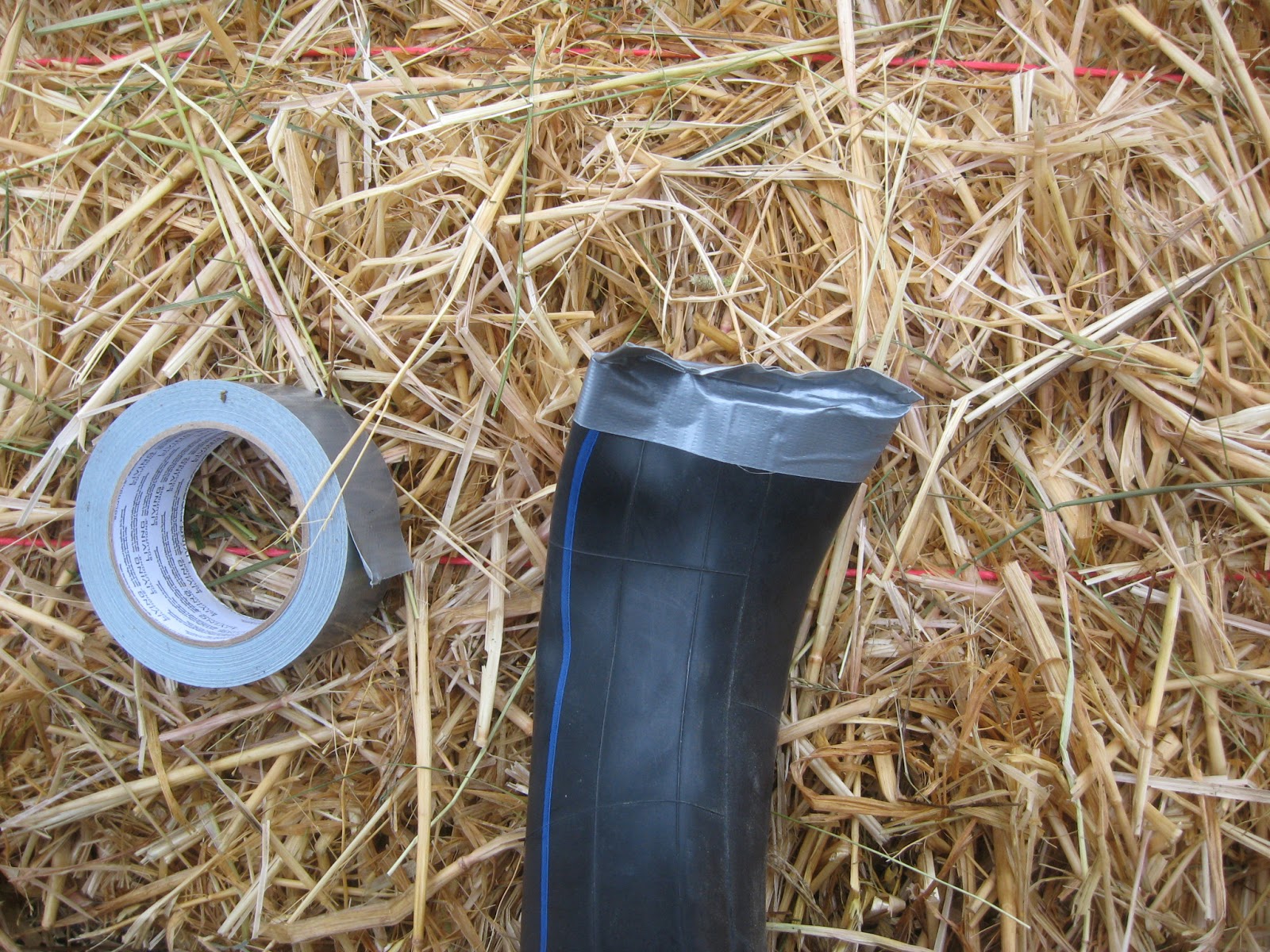
At this point, slide the tube over the foot with the curve of the tube following the curve of the leg.  Depending on the size of the foot you are dealing with, it may be helpful to put a slit in the top of the boot so that it will go on and off easier and fit the leg better.  Once in place, you will need to wrap the business end with more tape to seal and shape it.  I fold the front of the tube up, curve the corners up and in and wrap with more tape.  Use the tape to shape the foot portion, just don't make it too tight or you will have to cut it to remove it.


(It is good to have more than one of these so that if one gets wet, you can switch off.)


If conditions are wet, I put a rubber glove over Ramsey's foot first....

followed by a plastic baggie.  This adds to the waterproofing and makes the tube easier to slip on and off.  It's like a sock.  A shopping bag would work for larger beasties.
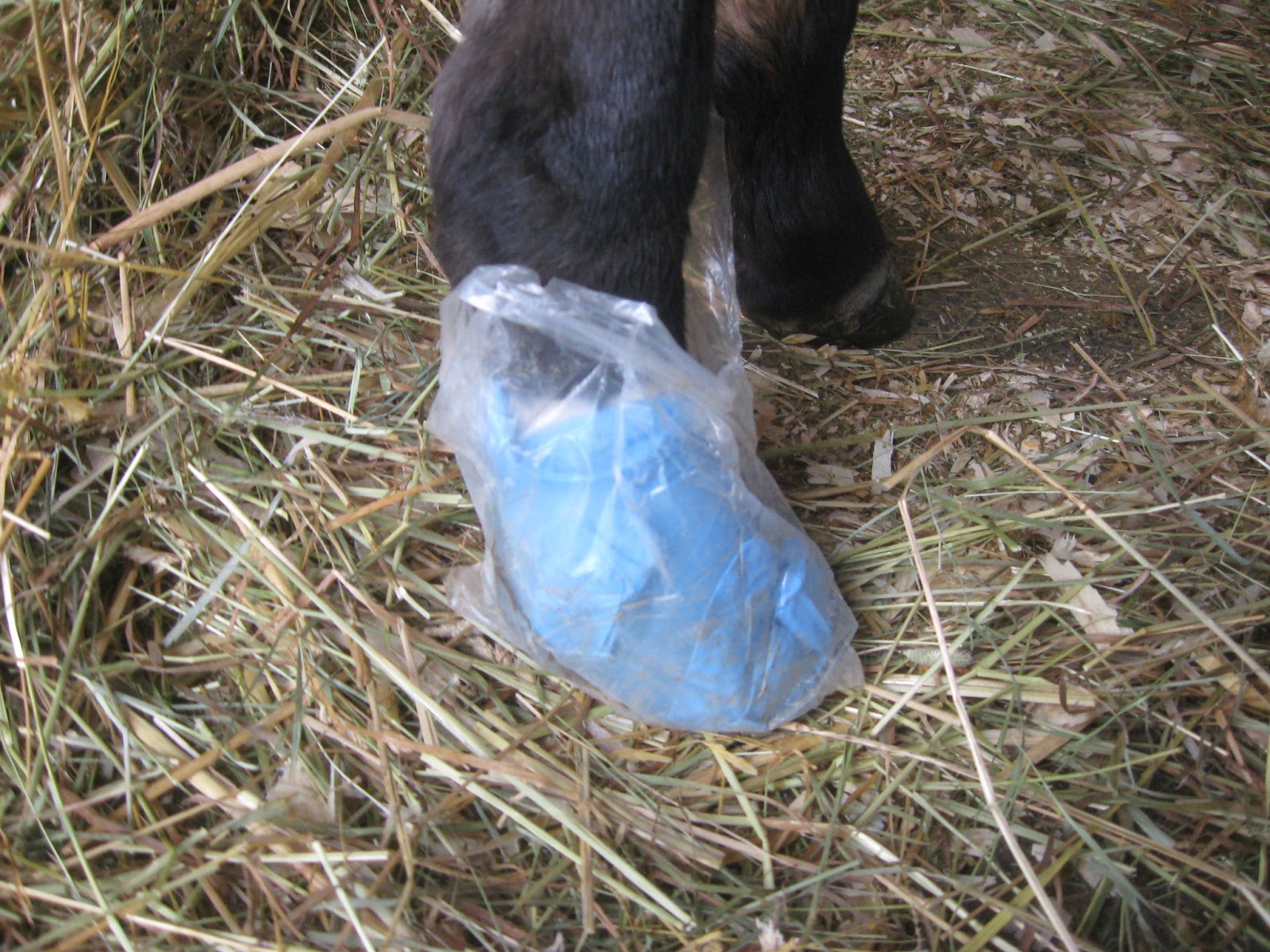
Once the boot is on, you will need to add a piece of tape around the pastern to keep it on as well as a piece around the cannon bone to keep snow and debris out. 


Depending on the weather, the bottom hoof-wrap portion generally holds up for about a week.  Less in wet weather and more if dry.  I may add a bit more tape throughout the week as reinforcement.  I try to make the tape on the bottom of his foot crinkle up some rather then be smooth as it helps provide some traction on slippery ground.  The tape around his pastern and cannon bones gets replaced every time I use the boot so you will go through a lot of tape.  Go ahead and buy the cheap stuff, it works just as well for this as the higher quality, expensive stuff.

As with all muck boots, this boot is a bit cumbersome and it is not breathable, but it does not hinder or bother Ramsey.  The boot can't be left on for more than a few hours at a time since it does not breath.  However, it allows Ramsey to have some freedom and exercise no matter the weather.  He gets to spend 2-3 hours a day out with mom and I take him for short walks at least twice a day.  It has gone a long way towards helping him heal, both physically and mentally.

Saturday, February 2, 2013

A Foot Update

It feels like progress has slowed a bit with Ramsey's foot.  The hoof wall is still growing fast, but the sole has a long way to go yet.  I think there is still a lot of dead tissue that needs out grow out before we get healthier hoof.  The back of the hoof wall keeps curving in toward the frog more and more as well.  I don't know if that is caused by the internal damage to the foot or the constant bandaging.  Since it has not happened on the other side of the hoof, I suspect the former with the latter possibly being a contributing factor.  I will share these photos with the vet, see what he says.

Right after I took these photos, I massaged some of my ointment into the foot and all of that scaly stuff on the side finally came off.

To me, it looks like the coronet band has become oddly stretched and elongated.  I have not ever seen anything like this before.  I really think it is the result of 3 months of constant bandaging and I have been trying to think of different ways to wrap the foot that would allow more air circulation, but I haven't come up with anything yet.  It has to be foolproof so I haven't dared experiment much.

In spite of how odd everything looks, Ramsey seems very sound on the foot.  He moves easily and freely with no limp and no sign of pain so I am not terribly worried.  I have been trimming the foot just a little bit each week, hoping to maintain it in tiny steps rather than trim it all at once weeks from now.  I think we will see much healthier growth once he can go without a bandage.

Speaking of bandages, I had been trying to stretch out the bandage changes to every 3-4 days, but I think I am going to have to go back to doing it every other day.  The back of his heels get so dry that the bandage rubs and chafes, making it sore.  I am still using my beeswax salve on it, which has really helped, but it needs to be reapplied more often.  I don't want him to get sore and I certainly don't want it to get infected again.  His heels were looking really good, but we seem to be losing ground so, back to every other day.  Not only is this time consuming, but between bandage materials and medicine, it costs about $10 every time I change it.  Oh well.  I have been trying to make the bandage lighter, but....

When I did this bandage change, I noticed that Ramsey now has a tiny white spot.  I don't think it is genetic though, it certainly wasn't there before.  It looks to me like a tiny scar, which often grow back in white.  It makes me wonder if this could have been the original injury that caused all of this.  I always assumed that it was a stone bruise that started everything, but it is possible that a puncture wound in the leg could have been the route in for bacteria. 

Both of the donkeys love to scrounge and nibble in whatever brush they can find, Ramsey could easily have punctured his leg on a twig or thorn.  Given how tiny this spot is and how thick and dark Ramsey's fur is, I doubt I would ever have seen it.  The actual scar under that white fur is about the size of a sesame seed.  

Ah well, now Ramsey can boast of a light point after all.


Tuesday, January 15, 2013

The Foot Today

I got a few pictures of Ramsey's foot this afternoon during the bandage change. 


The farrier at Cornell took off a lot of excess hoof.  The constant bandaging has made the coronet band flatten and creep upwards giving the foot a stretched and overly long look.  The foot is still overly long, but it couldn't be cut back any further, it will have to wear back over time once the bandage is no longer needed.

As you can see from the position of the surgical hole, the foot has grown over an inch since he had surgery.  Hopefully, once it grows out enough that the it no longer needs bandaging, it will start growing and wearing more normally.  I have never seen a foot that has had to remain bandaged for so long and the results are interesting.  It definitely shows how too much constricture can cause problems.  I often see horses with hoof problems that I believe are caused by wearing too-small shoes.  Ramsey's foot certainly demonstrates how those problems begin. 

I think that with careful trimming, I will be able to correct the issues in Ramsey's foot over time once we can get back to normal.  The foot is too tall and the heels are very contracted.  Both are very common problems for young donkeys and they have been exacerbated by 10 weeks of bandaging. 

The bottom of the foot shows that will still have quite a ways to go.  Sorry for the odd camera angle, the foot isn't really that off-center, it's just darned hard to get pictures.  Another case of needing more than two hands.

The spot just in front of my finger is where the sensitive, internal structures of the foot are still exposed.  If you follow the curve of the foot upwards, you can see light and dark patches in the sole.  The light color on the right is healthey sole, the grey and black on the left is where the abscess traveled under the sole, undermining the whole hoof.  All of that black and grey is going to die off and be repleced over time.  You can really see just how extensive the infection was as there isn't much healthy sole left.  The foot will have to stay clean, dry and bandaged until good hoof grows over the internal strucures and he has a bit more healthy sole to support him. 

He is going to loose a lot more of the frog as well (that's the dark, triangular bit at the back of the foot), but it will regenerate with time.  I think he will have to regrow the whole foot before it is normal again, which may take as much as a year, but I think we will get there.  Someday.


Tuesday, December 4, 2012

The Foot

A number of people who have donkeys of their own have sent me emails expressing interest in what has happened to Ramsey's foot and how it was treated.  I took these photos yesterday to show you what it looks like and as a way for me to better track his progress.  Since I look at it every day, it can be hard to see progress.

Be warned, these are bit graphic.  If you are not interested in such details, you might want to skip this post.

Ramsey had a lateral hoof-wall resection done so that the surgeon could access the coffin bone, which was infected.  About 1/4 of the coffin bone was removed.  There is a fair amount of granulation tissue, but obviously, it needs a lot more.  I am treating this part of his hoof with a chelated silver solution.  I soak a piece of gauze in the solution, put it directly in the hole and use conforming gauze to wrap over it.

As the hoof grows from the top down, the hole will move farther and farther down toward the ground and eventually grow out.  The resection is causing him surprisingly little pain at this point.  He no longer even flinches when I replace the gauze packing.  Hopefully, when he goes back to Cornell in four weeks, the foot will be healed and grown out enough that they can put an acrylic patch over the hole and eliminate the need for a bandage until it grows out completly.

The most painful part right now is the back of his heel.  You can see, just where my thumb is and at the coronet band above the resection, that the hide is scurfing off where the bandage has rubbed and the abscess broke out. 

I used a small amount of icthammol on that area and I am going to try some of the beeswax salve that I make.  I think it will provide a protective barrier and help keep things soft.  The foot is in need of a trim, but that cannot be done at this time.  

I need Ramsey to stand still and quiet while I change his bandage.  While he does tie fairly well, he is too wiggly without a distraction.  I have found that if I offer him something good to eat, he will stand quietly and allow me to do just about anything while the food holds out.  Since I do not want him overeating and he should not get any grain, I have been giving him a small handful of timothy hay pellets soaked in water (you can get the pellets at TSC).  They are the perfect choice for animals who should not get carbohydrates and I have used them to completely replace the minuscule amount of grain my equines were getting, none of them need grain.  All of them actually like the hay pellets better than sweet feed, which surprised me.  The pellets contain nothing but timothy hay and a small handful keeps Ramsey happily occupied for nearly 30 minutes.   

That 30 minutes gives me ample time to get this done....